Small-batch sauce makers need equipment that can separate skins and seeds quickly without creating unnecessary cleanup or bottlenecks. The right tomato press can turn harvest-day processing into a more consistent, repeatable workflow.
This roundup compares 10 electric and manual models across power, throughput, materials, hopper size, and operating style, so you can choose a machine that matches your production volume and workspace.
Best 10 Tomato Presses for Small Businesses Picks for 2026
Compact Electric Pick
OMRA Spremy 850 Tomato Strainer

- Handles up to 330 pounds per hour
- Automatically separates skins and seeds
- Compact 220V design made in Italy
Best For: Small businesses needing portable electric tomato processing
Manual Batch Pick
Weston Stainless Steel Tomato Strainer
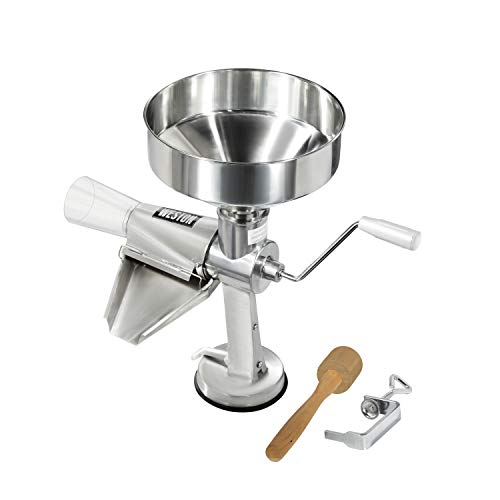
- One-gallon hopper for manual batch processing
- Suction-cup and C-clamp mounting options
- Includes stomper and 1.5mm screen
Best For: Hands-on kitchens and farm businesses without electric processing needs
Heavy-Duty Production Pick
Reber N.5 Electric Tomato Strainer

- Rated output up to 772 pounds per hour
- 650W induction motor with oil-bath gearbox
- Optional attachments broaden food-processing use
Best For: High-volume small producers needing durable, multipurpose equipment
Commercial-Grade Value Pick
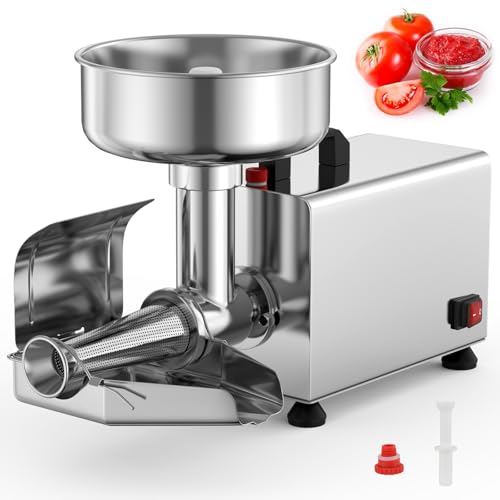
- Processes a stated 200-350 pounds per hour
- Uses 110-120V power and a large feed chute
- Tool-free disassembly with dishwasher-safe parts
Best For: Small commercial kitchens prioritizing throughput and easier cleanup
Best All-Around Batch Option
Weston Deluxe Electric Tomato Strainer

- 1-gallon hopper for moderate batches
- Three stainless-steel screens included
- 250-watt motor with forward and reverse
Best For: Small sauce makers and seasonal processors
Best High-Output Commercial Pick

- Processes up to 330 pounds per hour
- 304 stainless-steel body
- Five-year warranty and lifetime support
Best For: Restaurants, farms, and commercial kitchens
Best Flexible Mounting Option
Johnny Model 250 Electric Food Strainer

- Electric motor plus hand-crank backup
- Four specialized screens included
- Clamp fits 3/4- to 2-1/8-inch countertops
Best For: Small producers needing flexibility and manual backup
High-Volume Harvest Pick
VEVOR 370W Electric Tomato Strainer

- Processes up to 200 pounds per hour
- Separates peels and seeds in one pass
- Tool-free disassembly simplifies cleanup
Best For: Small businesses handling seasonal sauce and canning batches
Maximum Throughput Choice
INTBUYING 450W Commercial Tomato Strainer

- 450W motor rated up to 330 pounds per hour
- Stainless steel, food-grade construction
- Handles tomatoes, berries, jams, and purees
Best For: Restaurants and cafes needing high-capacity batch processing
Easy-Handling Commercial Pick

- 370W pure copper motor for batch processing
- 304 stainless steel food-contact parts
- Adjustable trough helps control sauce discharge
Best For: Small kitchens making tomato and fruit sauces
Compact Electric Pick – OMRA Spremy 850 Tomato Strainer
For small businesses seeking tomato presses for small businesses, the OMRA Spremy Electric Tomato Strainer 850 offers a compact electric option for fresh or cooked processing. Its 1/4 HP motor and masticating-style auger are designed to separate puree from skins and seeds while handling up to 330 pounds per hour.
Best For: Small-scale commercial kitchens and businesses that need a portable, Italian-made electric strainer for tomatoes or apples.
Pros:
- Processes up to 330 pounds of tomatoes per hour.
- Separates puree from seeds and skins automatically.
- Features a die-cast metal housing, stainless steel hopper, and food-grade nylon auger.
- Cooling-fan-equipped 1/4 HP motor and portable design.
Cons:
- Uses 220-volt corded power, which may not suit every workspace.
- Its stated capacity is lower than the largest commercial models in this roundup.
The OMRA is a practical middle-ground choice when space and portability matter, but buyers should confirm that their electrical setup supports 220 volts.
Manual Batch Pick – Weston Stainless Steel Tomato Strainer
The Weston Metal Tomato Strainer is a manual choice for businesses looking for tomato presses for small businesses without adding an electric motor. Its one-gallon hopper, smooth-turning handle, and included 1.5mm screen support batches of tomato sauce, puree, jam, and salsa.
Best For: Small food businesses, farm stands, and kitchens that prefer hands-on processing and flexible countertop or garden-table placement.
Pros:
- One-gallon stainless steel hopper supports larger manual batches.
- Dual mounting system uses either a suction-cup base or C-clamp.
- Stainless steel splash guard and chute help direct puree cleanly.
- Includes a stomper and 1.5mm multipurpose screen for tomatoes and apples.
Cons:
- Manual operation requires continued hand turning.
- Additional screens are sold separately.
This Weston model suits operations that value simple placement and no electrical requirement, though higher-volume users may prefer an electric press.
Heavy-Duty Production Pick – Reber N.5 Electric Tomato Strainer
For high-volume tomato presses for small businesses, the Reber N.5 emphasizes sustained production with a 650W induction motor and an output rated up to 772 pounds per hour. Its oil-bath gearbox, metal gears, and stainless steel processing components are aimed at demanding sauce and preserve work.
Best For: Small commercial producers with heavy workloads who also want the option to process jams, fruit juices, and other foods with compatible attachments.
Pros:
- Rated for output up to 772 pounds per hour.
- 650W induction motor and maintenance-free oil-bath gearbox support continuous operation.
- Cast-iron body and all-metal gears provide a solid, durable construction.
- Optional attachments can expand use to pasta, meat grinding, grating, and mixing.
Cons:
- Its larger 20.5-inch width requires substantial counter or workspace room.
- Removable components are specified for hand washing only.
- Additional attachments are optional rather than included.
The Reber is the strongest production-oriented option here, especially for businesses that can accommodate its larger footprint and want a multipurpose platform.
Commercial-Grade Value Pick – COSTWAY 450W Tomato Strainer
The COSTWAY 450W Electric Tomato Strainer is built for businesses comparing tomato presses for small businesses with a focus on throughput and cleanup. Its full-copper motor is rated for 200 to 350 pounds per hour, while tool-free disassembly and dishwasher-safe detachable parts simplify routine processing.
Best For: Small commercial kitchens and preserve makers who need a 110-120V electric machine for tomatoes and assorted fruits.
Pros:
- Rated to process 200 to 350 pounds per hour.
- Large 8.5-inch feed chute and included safety pusher support steady feeding.
- Food-grade 304 stainless steel construction.
- Tool-free disassembly and dishwasher-safe detachable parts help with cleanup.
Cons:
- Product care instructions also specify hand washing, so cleaning guidance may require attention.
- At 22 pounds, it is less lightweight than the most compact option.
- Its stated capacity is below the Reber’s maximum output.
The COSTWAY balances useful commercial capacity with familiar 110-120V power, making it a practical fit for operations that want easier maintenance without moving to the largest machine.
Best All-Around Batch Option – Weston Deluxe Electric Tomato Strainer
For small businesses that need dependable tomato presses for small businesses, the Weston Deluxe offers a practical balance of batch capacity, flexible screening, and straightforward electric operation. Its 250-watt motor, two speeds, and 1-gallon hopper suit sauce, salsa, puree, and preserving work.
Best For: Small sauce makers and seasonal processors handling moderate batches of tomatoes and other soft produce.
Pros:
- 1-gallon hopper supports larger batches.
- Includes 1.5mm, 3mm, and 6mm stainless steel screens.
- Forward and reverse speeds help with extraction and jam prevention.
- Stomper supports safer feeding into the hopper.
Cons:
- Its 250-watt motor is less powerful than the higher-output commercial model in this roundup.
- Plastic and stainless-steel construction may be less heavy-duty than an all-stainless design.
The Weston is a versatile choice when your business needs multiple texture options without moving to a larger commercial machine. The one-year warranty and 120-volt operation may also fit smaller production setups.
Best High-Output Commercial Pick – ARINOO 450W Tomato Strainer
Among tomato presses for small businesses, the ARINOO stands out for businesses prioritizing throughput and stainless-steel construction. Its 450-watt copper motor is rated for processing up to 330 pounds per hour, while the dual-channel design separates skins and seeds from the pulp.
Best For: Restaurants, farms, and commercial kitchens processing substantial quantities of tomatoes, berries, or other suitable produce.
Pros:
- Rated capacity of up to 330 pounds per hour.
- Food-grade 304 stainless-steel construction is rust-resistant.
- Enclosed motor housing, safety guard, and included push rod support safer operation.
- Includes a five-year manufacturer warranty and lifetime customer support.
Cons:
- Requires a five-minute cooling period after every 15 minutes of continuous use.
- Hand-wash care may make cleanup more involved than with some appliances.
- At 20.9 pounds, it is less convenient to move frequently.
The ARINOO is the strongest fit for a small commercial operation where speed and durability matter more than portability. Confirm that its 110-volt corded setup and cleaning requirements match your workspace.
Best Flexible Mounting Option – Johnny Model 250 Electric Food Strainer
The Johnny Model 250 is a flexible option for small businesses looking for tomato presses for small businesses that can adapt to different production tasks. It combines an electric motor with a hand-crank design and includes screens for fine sauces, tomato processing, pumpkin puree, and chunky salsa.
Best For: Small producers who want manual backup, varied screen sizes, and a countertop clamp mount.
Pros:
- Can run with the electric motor or supplied hand crank.
- Includes berry, apple/tomato, pumpkin, and salsa screens.
- Clamp mounts to countertops from 3/4 to 2-1/8 inches thick.
- Five-year warranty and BPA-free plastic components.
Cons:
- Its 8-pound design and clamp mounting are better suited to smaller batches than high-volume production.
- The supplied details do not state a processing rate or motor wattage.
- Setup requires a suitable countertop with enough clamping space.
This model makes sense when versatility and a manual fallback are valuable. Its broad accessory set supports multiple recipes, but businesses with continuous high-volume needs may prefer the higher-capacity ARINOO.
High-Volume Harvest Pick – VEVOR 370W Electric Tomato Strainer
For small businesses comparing tomato presses for small businesses, the VEVOR combines a 370W motor with a large hopper and stainless steel components. It separates peels and seeds in one pass and is designed to process large batches for sauce, puree, juice, jam, and canning.
Best For: Small food businesses and seasonal processors that need efficient batch tomato processing with straightforward cleanup.
Pros:
- Processes up to 200 pounds per hour, according to the product title.
- Stainless steel filter screen separates peels and seeds for smoother results.
- Large hopper reduces frequent refilling during higher-volume work.
- Core components disassemble without tools for quick rinsing.
Cons:
- Tomatoes should be cut into small pieces to help reduce clogging.
- At 21.7 pounds, it requires a dedicated storage or work area.
The VEVOR is a practical choice when batch capacity, durable food-contact materials, and reduced cleanup matter more than compact storage.
Maximum Throughput Choice – INTBUYING 450W Commercial Tomato Strainer
Businesses seeking tomato presses for small businesses may prefer the INTBUYING when throughput is the priority. Its 450W motor is rated to squeeze up to 330 pounds of ketchup per hour, while the stainless steel body, large funnel, and adjustable discharge trough support extended batch processing.
Best For: Restaurants, cafes, and small production kitchens that need high stated capacity and versatility for sauces, jams, and fruit purees.
Pros:
- 450W motor is rated for up to 330 pounds per hour.
- Food-grade stainless steel construction is designed for durability and easier cleaning.
- Large funnel supports feeding substantial amounts of fruit.
- Processes tomatoes, berries, and other fruits for sauces, jams, and purees.
Cons:
- Its 21.06-inch length and 20.94-pound weight call for adequate counter and storage space.
- The machine is specified for 110V / 60Hz operation.
The INTBUYING stands out for small commercial operations that value the highest stated capacity in this group and want one machine for both tomato products and fruit-based preparations.
Easy-Handling Commercial Pick – VBENLEM 370W Tomato Strainer
For buyers evaluating tomato presses for small businesses, the VBENLEM offers a commercial-grade 370W pure copper motor, full stainless steel construction, and a 9-inch feeding funnel. Its adjustable trough is intended to support smooth sauce discharge while helping limit splashing.
Best For: Small commercial kitchens that want a durable electric strainer for tomato sauce, ketchup, and small-batch fruit sauces.
Pros:
- Pure copper 370W motor is designed for continuous operation.
- Food-contact parts use 304 stainless steel and are easy to disassemble.
- Adjustable trough and brace help guide discharge and reduce splashing.
- Low-noise operation and a level II waterproof rating support easier cleaning.
Cons:
- The listed capacity information varies between 90–160 kg/h and 100 kg.
- At about 22 pounds, it is not a lightweight countertop appliance.
- The listed material type is aluminum, despite the notes describing full stainless steel construction.
The VBENLEM is a solid fit when durable construction, guided sauce discharge, and easy disassembly are central buying considerations, though capacity specifications should be confirmed before purchase.
How We Picked the Best Tomato Presses for Small Businesses
We focused on the practical demands of small commercial kitchens, farm stands, caterers, restaurants, and specialty food producers. Our comparison considers motor power, stated processing capacity, construction materials, feed-hopper size, ease of cleaning, and whether each machine is better suited to occasional batches or frequent production.
Capacity claims can vary with tomato variety, ripeness, preparation, and operator technique. Treat advertised pounds-per-hour figures as benchmarks rather than guaranteed output. We also considered the trade-off between electric convenience and manual control, along with the availability of replacement parts and accessories.
Quick Comparison
| What to Compare | Best Fit | Why It Matters |
|---|---|---|
| Motor power | Frequent or dense batches | Higher wattage can help maintain processing speed under load. |
| Throughput | Commercial or seasonal production | Reduces time spent processing large harvests. |
| Manual operation | Low-volume or intermittent use | Avoids electrical dependence but requires more physical effort. |
| Stainless-steel construction | Food businesses and heavy use | Usually offers durability and easier sanitation. |
| Compact design | Small kitchens and storage areas | Uses less counter and storage space between batches. |
Key Buying Factors for Tomato Presses for Small Businesses
Capacity and Workflow
Choose a press based on your typical batch size, not the largest possible harvest. A high-capacity machine is useful when processing hundreds of pounds, but it may be unnecessary for a restaurant making sauce once or twice a week. Consider hopper size, continuous-feed operation, and how quickly the machine can be disassembled between batches.
Power and Electrical Requirements
Check wattage, voltage, outlet requirements, and duty cycle before buying. Many commercial-style units use standard household voltage, but a powerful motor may still require a dedicated circuit. A machine that runs steadily without overheating is more valuable than one with a high headline rating but limited practical endurance.
Materials, Sanitation, and Maintenance
Stainless steel is a strong choice for food-service environments because it resists corrosion and is relatively easy to sanitize. Confirm which parts are removable, whether components are dishwasher-safe, and how readily you can obtain replacement screens, augers, gaskets, and blades. Always follow the manufacturer’s cleaning instructions.
Yield and Adjustability
Screen design affects how finely skins and seeds are separated and how much pulp is recovered. If you process different tomato varieties or other soft produce, look for interchangeable screens or adjustable settings. Pre-cooking or cutting tomatoes may also improve feeding and yield.
Who Should Buy Which Tomato Presses for Small Businesses?
Choose a higher-capacity electric model if you run a farm stand, commercial kitchen, or seasonal preserving operation and need consistent output with less manual labor.
Choose a compact electric press for restaurants, caterers, and small food businesses that process regular but moderate batches and value quick setup and storage.
Choose a manual strainer if your production is occasional, electricity is limited, or you want the lowest upfront cost and straightforward operation.
Before ordering, verify the machine’s voltage, stated capacity, food-contact materials, included screens, warranty, and replacement-part availability. The best Tomato Presses for Small Businesses are the ones that fit your real batch size, cleaning routine, and available workspace.