Manual grain mills offer a dependable way to turn wheat, corn, oats, rice, and other dry grains into fresh flour without relying on electricity. The right model can support everyday baking, emergency preparedness, or small-batch food processing.
This roundup compares 10 hand-operated mills, from compact clamp-on designs to larger flywheel models. We focus on grinding control, construction, capacity, cleanup, and how comfortably each mill fits a real kitchen or homestead workflow.
Best 10 Manual Grain Mills Picks for 2026
Heavy-Duty Pick
Victoria 2400g High-Hopper Grain Mill

- Cast iron construction with adjustable grinding
- Large 2400g capacity and high hopper
- Clamps to tables 1/2 to 2 inches thick
Best For: Larger-batch, multi-purpose grinding
Lifetime-Warranty Pick
Country Living Hand Grain Mill

- Cast aircraft aluminum construction
- Adjusts from cracked grain to cake flour
- Includes a lifetime warranty
Best For: Durability-focused home grinding
Compact Cast-Iron Pick
Victoria 1200g Low-Hopper Grain Mill

- Cast iron body with adjustable grind control
- 1200g low-hopper configuration
- Clamps to tables 1/2 to 2 inches thick
Best For: Smaller-batch everyday grinding
Lightweight Versatility Pick
Kitchen Crop Stainless Steel Grain Mill
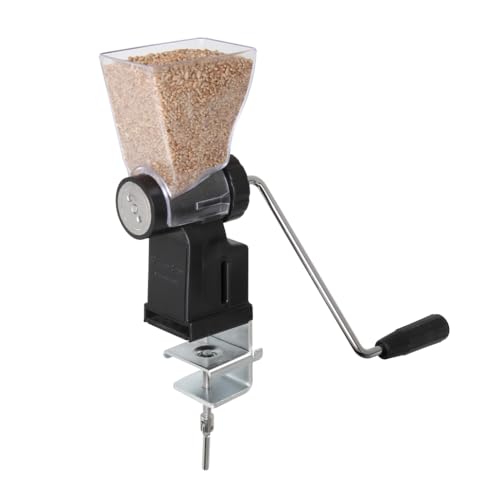
- Less than 3 pounds with a compact design
- Adjusts from cracked grain to bread-quality flour
- Supports manual use and optional electric drive
Best For: Portable small-batch grinding
High-Capacity Homestead Mill
Lehman's Manual Power Grain Mill

- 6-cup hopper for larger batches
- Polished stainless steel grinding burrs
- Large flywheel and motorization option
Best For: Home baking and homestead grinding
Versatile Countertop Classic

- Adjustable coarse-to-fine grinding
- Cast-iron construction with food-safe tin plating
- Clamp, handle, plates, and hardware included
Best For: Everyday countertop grinding and masa preparation
Adjustable Multi-Ingredient Grinder

- Adjustable settings for fine or coarse results
- Processes dry grains, spices, herbs, and coffee
- Large hopper and flywheel for efficient hand use
Best For: Versatile home, camping, and preparedness grinding
Best Heavy-Duty Capacity

- Large 0.53-gallon hopper
- Three adjustable grind settings
- Stable carbon-steel construction
Best For: Larger batches and versatile home grinding
Best Versatile Manual Option

- Electricity-free hand operation
- Handles grains, coffee, and spices
- Adjustable grind for varied textures
Best For: Home, camping, survival, and everyday dry grinding
Best for Small Batches

- Secure table-clamp mounting
- Low hopper for small batches
- Dust cover helps contain powder
Best For: Controlled small-batch grinding at a fixed workstation
Heavy-Duty Pick – Victoria 2400g High-Hopper Grain Mill
For shoppers comparing manual grain mills, the Victoria 2400g model stands out for its heavy-duty cast iron construction and high hopper. Its adjustable screw supports different textures, while the clamp and rubber protector help keep it stable during use.
Best For: Larger-batch grinding, home brewing, corn, grains, coffee, seeds, spices, and other varied kitchen tasks.
Pros:
- Durable cast iron body with double tin plating and erosion-resistant discs.
- High 2400g capacity for longer grinding sessions.
- Adjustable grind setting and clamp for tables 1/2 to 2 inches thick.
- Versatile enough for grains, coffee, vegetables, nuts, spices, and more.
Cons:
- Cannot produce a superfine texture or fine whole-wheat powder.
- At 4.4 pounds, it is less portable than compact alternatives.
- Covered by a 90-day limited warranty.
This is a practical choice when durability, capacity, and versatility matter more than ultrafine flour production. The high hopper and sturdy clamp make it well suited to regular countertop use.
Lifetime-Warranty Pick – Country Living Hand Grain Mill
The Country Living Hand Grain Mill is a substantial option among manual grain mills, built from solid cast aircraft aluminum with double-sealed industrial-grade ball bearings. Its adjustable design is intended to handle everything from cracked grain to cake flour.
Best For: Home users seeking a robust, adjustable mill with a long-term warranty.
Pros:
- Solid cast aircraft aluminum construction.
- Double-sealed industrial-grade ball bearings.
- Adjustable from cracked grain to cake flour.
- Backed by a lifetime warranty.
Cons:
- Weighs 16 pounds, making it notably heavy to move or store.
- Has a 2-pound stated capacity.
- Its supplied notes do not specify a clamp or mounting method.
Choose this model if long-term durability and a broad adjustment range are priorities. Its heavy build may be less convenient for occasional users who need a lightweight mill.
Compact Cast-Iron Pick – Victoria 1200g Low-Hopper Grain Mill
The Victoria 1200g Low-Hopper Grain Mill offers the traditional feel of cast iron in a lower-profile format. It uses an adjustable screw and white iron discs for coarse-to-fine grinding, with a clamp designed for tables 1/2 to 2 inches thick.
Best For: Everyday small-batch grinding of grains, corn, coffee, seeds, spices, and other ingredients.
Pros:
- Heavy-duty cast iron construction with double tin plating.
- Adjustable screw supports different grind textures.
- Low hopper design and 1200g capacity suit smaller batches.
- Rubber protector helps prevent slipping and surface damage.
Cons:
- Cannot grind to a superfine texture or fine whole-wheat powder.
- At 9.4 pounds, it is heavy for its capacity.
- Includes only a 90-day limited warranty.
This model makes sense for buyers who want a sturdy manual mill without the taller high-hopper configuration. It is versatile, but its coarse-to-fine range has limits for flour-focused applications.
Lightweight Versatility Pick – Kitchen Crop Stainless Steel Grain Mill
Kitchen Crop Hand Crank Grain Mill Wheat Flour Grinder, Stainless Steel Metal Burrs (The Grain Mill)
Check Price On AmazonFor shoppers who prioritize portability, the Kitchen Crop is one of the more compact manual grain mills available. Stainless steel burrs and an adjustment dial support textures from cracked grains and cereal to bread-quality flour, while the included hand crank can later be paired with an optional electric motor.
Best For: Small-batch grinding when compact storage, adjustable texture, and future electric operation are useful.
Pros:
- Weighs less than 3 pounds for easy storage and transport.
- Stainless steel burrs handle many dry, non-oily grains and seeds.
- Adjustment dial ranges from coarse textures to bread-quality flour.
- Clamp secures to counters and tables up to 2 inches thick.
Cons:
- Designed for dry, non-oily grains and seeds rather than oily ingredients.
- Two-cup hopper is oriented toward small batches.
- Optional electric drive motor is sold separately.
This is a strong fit for kitchens where space and portability matter. Its manual operation is convenient out of the box, while motor compatibility gives it added flexibility if your grinding needs increase.
High-Capacity Homestead Mill – Lehman's Manual Power Grain Mill
For shoppers comparing manual grain mills, Lehman’s model stands out for its large capacity and momentum-assisted hand grinding. It handles free-flowing dry grains such as wheat, corn, rye, rice, quinoa, and small beans, producing textures down to pastry flour.
Best For: Home bakers, homesteaders, and users who want a high-capacity mill that can also be motorized.
Pros:
- Large 6-cup hopper supports bigger grinding batches.
- Stainless steel burrs are electrolytic polished for a smooth, clean grinding surface.
- 12-inch iron V-belt flywheel adds momentum for easier hand operation.
- Four pre-drilled base holes allow secure bolting to a work surface.
Cons:
- At 26 pounds and 14 inches high, it is less portable than smaller hand mills.
- Designed for free-flowing, dry ingredients rather than wet or sticky materials.
- Motorization is possible, but the motor is not included in the supplied details.
This is a substantial manual grain mill for buyers who prioritize capacity, stability, and the option to add motor power later. Its larger footprint makes it better suited to a dedicated kitchen or workshop setup than occasional travel use.
Versatile Countertop Classic – Corona Manual Grain Mill
Among manual grain mills, the Corona is a practical cast-iron option for everyday countertop grinding. Its adjustable plates can produce coarse or fine results from corn, wheat, rice, coffee, spices, and other dry ingredients.
Best For: Home cooks making masa, tortillas, tamales, flour, cracked grains, spices, or ground coffee.
Pros:
- Adjustable grinding supports coarse-to-fine textures.
- Heavy-duty cast-iron body is built for repeated domestic use.
- Includes the hopper, plates, clamp, handle, mounting hardware, and stabilizing pad.
- Countertop clamp fits surfaces up to 1.45 inches thick.
Cons:
- Its 1.4-pound capacity is smaller than the large-hopper mills in this roundup.
- It requires a suitable countertop or table for clamping during use.
- Cast iron can be less convenient to move and maintain than lighter materials.
The Corona is a well-rounded choice when adjustable texture and broad kitchen use matter more than maximum capacity. Its included mounting hardware and stabilizing pad make it a straightforward manual mill for a fixed countertop station.
Adjustable Multi-Ingredient Grinder – Manual Hand Grain Mill White
This manual grain mill is designed for users who want one hand-crank grinder for dry grains, spices, herbs, nuts, and coffee beans. Its stainless steel grinding discs, adjustable setting, and large flywheel support both fine processing and coarser grist without electricity.
Best For: Home kitchens, camping, and preparedness setups needing a versatile dry-ingredient grinder.
Pros:
- Adjustable grind setting accommodates fine results and coarser grist.
- Handles a broad range of dry ingredients, including wheat, corn, oats, rice, spices, and coffee beans.
- Large hopper and flywheel support higher-volume hand grinding.
- Can be belt-driven with a suitable motor.
Cons:
- Wet, fresh, oily, and sticky materials are not suitable.
- At 28.6 pounds, it is relatively heavy for a portable hand mill.
- Its larger dimensions require substantial storage or counter space.
This model makes sense for buyers who value ingredient flexibility and adjustable results. It is capable and adaptable, but its size and weight favor a permanent setup or planned use rather than casual transport.
Best Heavy-Duty Capacity – VEVOR Flywheel Grain Mill
For shoppers comparing manual grain mills, this VEVOR model emphasizes capacity, stability, and versatility. Its 0.53-gallon hopper and carbon-steel construction suit larger prep jobs involving grains, corn, spices, coffee beans, and nuts.
Best For: Home users who want a large-hopper mill for versatile, repeated grinding.
Pros:
- Large 0.53-gallon hopper supports bigger batches.
- Three settings provide coarse, medium, and fine grinding.
- Wide base helps reduce vibration during operation.
- Flywheel supports hand-crank use and optional belt or motor drive; motor is not included.
Cons:
- At 32.2 pounds, it is relatively heavy to move.
- The larger footprint may require dedicated counter space.
- Finer results may require multiple passes.
This is a substantial manual grain mill for buyers who prioritize capacity and a stable setup over portability. Its adjustable settings and broad ingredient compatibility make it a practical all-purpose option.
Best Versatile Manual Option – Blue Hand Grain Mill
This blue hand-operated mill is a flexible choice among manual grain mills for users who want cord-free grinding at home, outdoors, or in a survival setup. It handles dry grains and can also process coffee beans and spices with fine adjustment.
Best For: Users seeking a manually powered mill for everyday, indoor, outdoor, or emergency use.
Pros:
- Works without electricity, cords, or batteries.
- Suitable for wheat, corn, rice, oats, coffee beans, and spices.
- Stainless steel grinding discs and powder-coated construction support food-focused use.
- Adjustable grinding degree accommodates coarse grist through fine powder.
Cons:
- Only dry ingredients should be ground; wet or oily materials are unsuitable.
- The extended crank creates a relatively wide operating footprint.
- Its listed 13-kilogram weight may limit portability.
With broad ingredient compatibility and an adjustable grind, this model offers strong flexibility for manual flour making. Just account for its size and use it only with dry ingredients.
Best for Small Batches – VEVOR Low-Hopper Grain Mill
For smaller portions, this VEVOR low-hopper model is a practical manual grain mill with a table-clamp design. The cast-iron body, adjustable grinding disc, and dust cover support controlled grinding of grains, spices, coffee beans, and nuts.
Best For: Users who need a compact, clamp-mounted mill for small-batch kitchen grinding.
Pros:
- Clamp secures to tables 0.79–1.58 inches wide.
- Low hopper is suited to small batches.
- Grinding fineness adjusts by tightening or loosening the disc.
- Dust cover helps limit powder scatter during use.
Cons:
- Small-batch design is less suited to high-volume milling.
- It requires a compatible table or work surface for clamping.
- Finer textures may require multiple grinding passes.
This model is a good fit when secure mounting and cleaner small-batch operation matter more than hopper capacity. Its cast-iron construction adds durability, while the clamp helps reduce shifting during cranking.
How We Picked the Best Manual Grain Mills
We compared these Manual Grain Mills by looking at the features that matter most during repeated use: burr or grinding-plate construction, adjustment range, hopper capacity, mounting stability, crank and flywheel design, material durability, and ease of cleaning. We also considered how well each style suits different grains and flour textures.
Cast iron and steel construction generally offer better durability than lightweight materials, but they can make a mill heavier and harder to move. Large flywheels may improve momentum and reduce the effort needed for steady grinding, while compact hand-crank models are easier to store and set up for occasional use.
Quick Comparison
- Best for maximum durability: Country Living and Lehman’s larger hand mills.
- Best for traditional value: Victoria and Corona cast iron designs.
- Best for compact storage: smaller hand-crank models with clamp or tabletop mounting.
- Best for adjustable grinding: models with clearly specified fineness controls.
- Best for heavy-duty versatility: mills with robust frames, large hoppers, and substantial flywheels.
Key Buying Factors for Manual Grain Mills
Grinding Mechanism and Flour Control
Check whether the mill uses burrs, plates, or another grinding mechanism, and confirm how easily the texture can be adjusted. Fine flour settings are important for bread and pastry, while coarse settings are useful for cracked grains, cornmeal, and cereal.
Mounting and Stability
A secure clamp or bolt-down base prevents the mill from shifting and makes hand cranking safer. Before buying, measure your counter or workbench and verify that the mounting hardware suits its thickness.
Capacity and Effort
A larger hopper reduces refilling but may add weight. Flywheel size, handle length, and overall gearing affect how tiring the mill feels during longer sessions. If you regularly grind several cups at once, prioritize leverage and stability over the smallest footprint.
Materials and Maintenance
Look for corrosion-resistant or well-finished components, accessible grinding parts, and instructions for cleaning and seasoning where applicable. Avoid storing residual grain inside the mill, especially in humid areas.
Who Should Buy Which Manual Grain Mills?
Choose a compact hand-crank mill if you have limited storage, grind occasionally, or want a straightforward backup for power outages. A traditional cast iron model is a practical choice for shoppers who value affordability, durability, and the ability to process common dry grains.
Frequent bakers and homesteaders should consider a larger, heavier mill with a substantial flywheel and dependable mounting system. These models are better suited to repeated batches and may feel smoother over extended use. If you need the finest flour possible, prioritize precise adjustment and verify the manufacturer’s grain and flour recommendations before purchasing.