Large-batch dough demands more than a powerful motor. Bowl capacity, kneading action, speed control, timer functions, and the machine’s footprint all affect how efficiently you can produce consistent bread, pizza, pasta, or sourdough.
We’ve selected 10 dough kneading machines for large batches, covering commercial floor-standing mixers and more compact countertop models. Use the guide below to match capacity, controls, durability, and workflow features to your baking needs.
Best 10 Dough Kneading Machines for Large Batches Picks for 2026
Commercial Capacity Pick
55-LB Stainless Steel Dough Mixer

- Kneads up to 55 lb (25 kg) per batch
- 2,200W motor with forward/reverse rotation
- 90° tilting stainless-steel barrel
Best For: High-volume restaurant and institutional kitchens
Versatile Commercial Pick

- 15-quart bowl handles up to 3.3 lb of food
- Includes hook, beater, and wire whip
- Three speeds and a 30-minute timer
Best For: Commercial kitchens needing one multi-purpose mixer
Home Precision Pick

- 7.3-quart rotating-bowl spiral mixer
- 58 speeds from 60 to over 1,000 RPM
- Four attachments for dough and general mixing
Best For: Home bread and pizza bakers wanting precise control
Dual-Rotation Value Pick
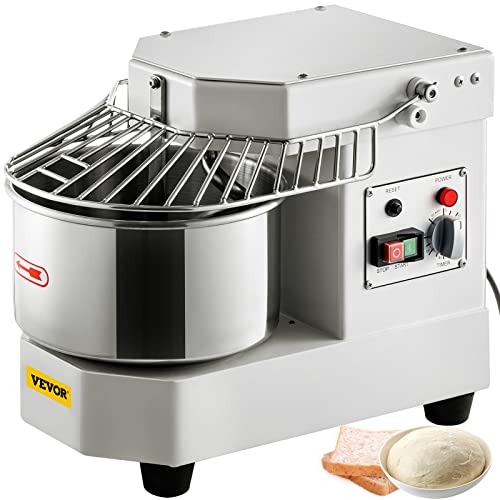
- Mixes up to 6.6 lb of dough per batch
- Dual rotation simulates manual kneading
- 60-minute timer and safety shield
Best For: Smaller commercial kitchens needing dough-focused mixing
Best Commercial Dough Mixer
10.5-Quart Dual-Rotation Mixer
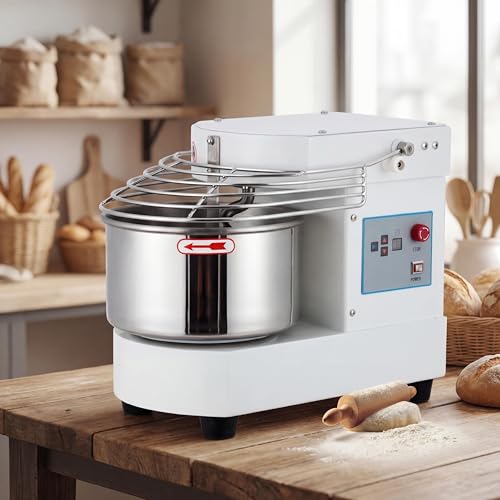
- Handles dough batches up to 11 pounds
- 650-watt motor with dual-motion mixing
- Touchscreen timer and safety interlock
Best For: Bakeries, restaurants, and food-service kitchens
Heavy-Duty Pick
INTBUYING 18Qt Commercial Dough Mixer
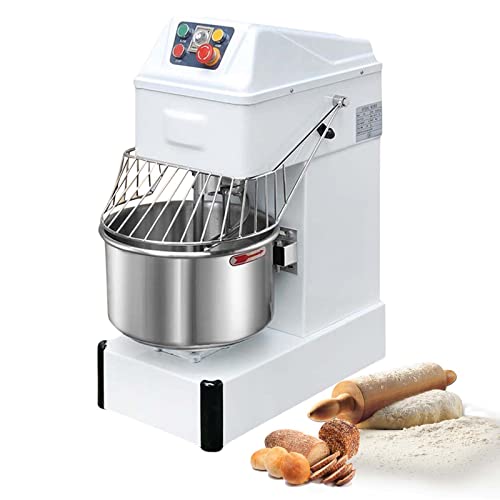
- 20-liter barrel handles up to 8 kg of dough
- 1,500W motor with dual-speed, dual-action mixing
- Timed operation and stainless steel construction
Best For: High-volume baking and commercial-style large batches
Home Fermentation Pick
AIZIYO DoughChief 5.3QT Dough Maker
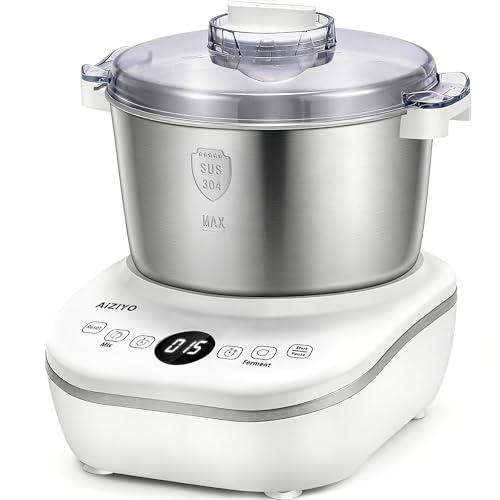
- Mix, ferment, and mix-and-ferment modes
- 5.3-quart 304 stainless steel bowl
- Compact design with removable, dishwasher-safe parts
Best For: Family-size baking with guided fermentation
Balanced Commercial Pick
13.8QT Electric Dough Maker with Ferment Function

- Handles up to 14.88 pounds of dough per batch
- Spiral hook and automatic 100–108°F fermentation
- Quiet 500W motor with 5–120-minute timer
Best For: Commercial or large-household baking on a countertop
Commercial Capacity Pick – 55-LB Stainless Steel Dough Mixer
For restaurants and other food-service operations comparing dough kneading machines for large batches, this 55-pound commercial mixer prioritizes capacity and straightforward dough handling. Its 2,200W motor, stainless-steel construction, and tilting bowl are suited to high-volume preparation.
Best For: Restaurants, canteens, noodle shops, breakfast stores, and hotel or school kitchens handling large batches of buns, dumplings, noodles, or meat fillings.
Pros:
- Handles up to 55 pounds (25 kg) of dough per batch.
- Forward and reverse rotation supports kneading and dough release.
- 90-degree tilting barrel simplifies unloading and rinsing.
- Food-grade stainless-steel construction is durable and easy to clean.
Cons:
- At 156.5 pounds, it is a substantial commercial unit.
- Its listed applications exclude bread and pizza making.
- The large footprint may require dedicated kitchen space.
This is the strongest capacity-focused option in the group, especially where peak-hour production matters. Choose it for large batches and specialized food-service dough work rather than general-purpose baking.
Versatile Commercial Pick – VEVOR 15-Qt Food Mixer
This VEVOR mixer is a practical choice among dough kneading machines for large batches when you also need to beat and whip. The 15-quart bowl, three attachments, three speeds, and built-in timer support a range of commercial kitchen tasks.
Best For: Bakeries, pizzerias, restaurants, and commercial kitchens mixing up to 3.3 pounds of food at a time along with cakes, fillings, creams, and other preparations.
Pros:
- Includes a dough hook, flat beater, and wire whip.
- Three speeds cover kneading, mixing, and whipping tasks.
- 30-minute timer reduces the need for constant monitoring.
- Food-contact parts are stainless steel and detachable for cleaning.
Cons:
- Its stated maximum food load is 3.3 pounds, smaller than the largest commercial mixer here.
- The machine should be stopped before changing speeds.
- At 127.9 pounds, it is not especially portable.
Its main advantage is versatility rather than maximum dough capacity. It makes sense for operations that want one mixer for dough, batters, fillings, and whipped mixtures.
Home Precision Pick – Ooni Halo Pro Spiral Mixer
For home bakers seeking dough kneading machines for large batches on a household scale, the Ooni Halo Pro combines spiral mixing with unusually fine speed control. Its rotating bowl, spiral hook, and removable breaker bar are designed to develop stronger dough structure.
Best For: Home users making bread and pizza dough who also want attachments for cakes, cookies, whipped cream, and frosting.
Pros:
- Spiral technology and a rotating bowl support dough development.
- Offers 58 speed settings from 60 RPM to over 1,000 RPM.
- Includes a spiral dough hook, flexible beater, geared whisk, and breaker bar.
- Compact dimensions suit a home countertop better than larger commercial units.
Cons:
- The 7.3-quart capacity is much smaller than a 25 kg commercial mixer.
- Its 14.6 kg weight may still be significant for frequent storage.
- It is positioned for home use rather than peak-volume food service.
This is the most refined choice for home dough work and recipe flexibility. Its capacity is appropriate for household batches, but commercial users needing very high output should look elsewhere.
Dual-Rotation Value Pick – VEVOR 8.5-Qt Dough Mixer
This VEVOR model offers a balanced approach to dough kneading machines for large batches, with an 8-liter bowl, dual rotation, and a 60-minute timer. Its bowl and hook rotate at different speeds to simulate a manual kneading action while keeping controls simple.
Best For: Smaller bakeries, restaurants, and food-preparation businesses mixing up to 6.6 pounds of dough per batch.
Pros:
- Mixes up to 3 kg (6.6 pounds) of dough at once.
- Dual rotation combines a 21 RPM bowl with a 159 RPM hook.
- 60-minute timer supports more hands-off operation.
- Safety shield, automatic shutoff, nonslip feet, and reset button add practical safeguards.
Cons:
- It has one listed speed, offering less adjustment than multi-speed mixers.
- The 450W motor and 8-liter bowl are not intended for the largest commercial batches.
- At 81.6 pounds, it remains a heavy countertop or workstation appliance.
Its dual-rotation design makes it a capable middle-ground option for dough-focused work. Select it when a 6.6-pound batch size is sufficient and kneading action matters more than attachment variety.
Best Home Dough Kneader – 7.4-Quart Dough Mixer
For home bakers comparing dough kneading machines for large batches, this 7.4-quart model combines hands-free kneading with a dedicated fermentation function. Its stainless steel bowl is designed for batches using 600–2,100 grams of flour, making it practical for family-size bread, pizza, pasta, and sourdough projects.
Best For: Family baking and home users who want large-batch kneading plus timed, temperature-controlled fermentation.
Pros:
- Handles up to 2.1 kg of dough and uses a food-safe 304 stainless steel bowl.
- Built specifically for bread, pizza, roti, pasta, and sourdough dough.
- Includes hands-free operation, timer controls, and fermentation heating from 77–100°F.
- Designed for reduced vibration, lower noise, and straightforward cleanup.
Cons:
- Its 200-watt motor is intended for home use rather than commercial production.
- The 7.4-quart capacity is smaller than the commercial mixer options in this roundup.
This is a well-rounded choice when convenience matters as much as capacity. The integrated fermentation feature is especially useful for bakers who want a more controlled dough-making routine without managing a separate proofing setup.
Best Commercial Dough Mixer – 10.5-Quart Dual-Rotation Mixer
If you need dough kneading machines for large batches in a bakery, restaurant, or food-service setting, this 10.5-quart commercial mixer offers substantially more capacity than typical home models. Its 650-watt copper motor, dual-motion mixing system, touchscreen timer, and safety shield are geared toward professional operation.
Best For: Commercial kitchens, bakeries, and restaurants preparing dough batches up to 11 pounds.
Pros:
- Large stainless steel bowl handles dough batches up to 11 pounds.
- 650-watt motor supports dual-motion mixing, with bowl and mixing rod rotating at separate speeds.
- Touchscreen controls provide digital timer and mixing-setting adjustments.
- Safety shield interlock pauses operation when the shield is opened, and the emergency stop button self-locks.
Cons:
- At 114.6 pounds, it is substantially heavier and less portable than home mixers.
- Its 19.5-by-11.9-by-18.1-inch footprint requires dedicated counter or floor space.
- The supplied notes do not specify fermentation functionality.
This is the strongest fit for buyers prioritizing batch capacity and commercial-style controls over portability. The heavy build and safety features suit a fixed workstation, while the touchscreen and dual-motion design support repeatable mixing tasks.
Best Fermenting Dough Maker – 7.4-Quart Dough Mixer
For shoppers seeking dough kneading machines for large batches with convenient ingredient adjustments, this 7.4-quart dough maker offers constant-temperature fermentation and a top window for adding water or seasonings. Its stainless steel construction and 7-liter capacity make it suitable for preparing multiple batches of bread, pizza, or pastry dough in one session.
Best For: Large-family baking and users who want built-in proofing with the ability to add ingredients without stopping the mixer.
Pros:
- 7.4-quart, approximately 7-liter capacity supports larger family-sized preparations.
- Constant-temperature fermentation helps provide a consistent proofing environment.
- Top ingredient window allows water, seasoning, or other additions during mixing.
- Includes touch controls, time setting, auto shutoff, and a stainless steel bowl.
Cons:
- Its single-speed design offers less mixing adjustment than models with multiple speeds.
- The 250-watt motor and compact capacity are better suited to home use than commercial production.
- The supplied details do not state a maximum dough weight.
This model stands out for its practical fermentation and ingredient-access features. It is a sensible option for home bakers who value simple controls and hands-on adjustments while making relatively large batches.
Heavy-Duty Pick – INTBUYING 18Qt Commercial Dough Mixer
For demanding dough kneading machines for large batches, the INTBUYING 18Qt Commercial Dough Mixer focuses on capacity, durability, and timed operation. Its 20-liter stainless steel barrel can handle up to 8 kg of dough, while the dual-action design and 1,500-watt motor support efficient mixing for bread and pizza dough.
Best For: High-volume home bakers, food businesses, and anyone regularly preparing large dough batches.
Pros:
- Handles up to 8 kg of dough in its 20-liter barrel.
- Dual-speed, dual-action mixing is designed for thorough, uniform kneading.
- Programmable timing supports low speed, high speed, surface time, and automatic stopping.
- Stainless steel construction and a protective cover support long-term, safer use.
Cons:
- At 270 pounds, it is far less portable than a countertop mixer.
- Its 24.4-inch depth and 34.4-inch height require substantial dedicated space.
- The 110-volt commercial design may be more machine than small households need.
This is the strongest capacity-focused option in the group. Choose it when batch size and robust construction matter more than compact storage or easy relocation.
Home Fermentation Pick – AIZIYO DoughChief 5.3QT Dough Maker
Among dough kneading machines for large batches, the AIZIYO DoughChief is the compact, home-oriented choice. Its 5.3-quart stainless steel bowl is suited to family-size dough portions, while mix, ferment, and mix-and-ferment modes simplify the transition from kneading to proofing.
Best For: Families and home bakers who want guided kneading and built-in fermentation in a compact appliance.
Pros:
- Mix-pause-mix operation is designed to mimic hand kneading and support gluten development.
- Dedicated fermentation mode helps streamline dough preparation.
- Removable lid allows ingredients to be added while mixing.
- Compact footprint, dishwasher-safe removable parts, and touch controls suit everyday kitchen use.
Cons:
- Its 5.3-quart capacity is smaller than the commercial mixers in this roundup.
- The 200-watt motor is intended for home baking rather than the heaviest production loads.
- The listed 75 dB noise level is higher than the larger mixer’s stated noise rating.
The DoughChief is best viewed as a family-size dough maker rather than a true commercial batch machine. Its fermentation features and compact design make it practical when convenience matters more than maximum capacity.
Balanced Commercial Pick – 13.8QT Electric Dough Maker with Ferment Function
This 13.8-quart electric dough maker offers a middle ground for shoppers comparing dough kneading machines for large batches. It can mix up to 14.88 pounds of dough or 9.92 pounds of flour per batch, while its spiral hook, fermentation function, timer, and removable bowl support efficient commercial or large-household baking.
Best For: Bakeries, cafeterias, restaurants, and large households needing substantial capacity without a floor-standing mixer.
Pros:
- 13.8-quart capacity supports up to 14.88 pounds of dough per batch.
- Spiral hook is designed for even mixing, with no dry flour left behind.
- Built-in fermentation uses automatic temperature control from 100–108°F.
- Quiet 500-watt motor, 5–120-minute timer, and detachable bowl simplify operation and cleanup.
Cons:
- It is less capacious than the INTBUYING machine for the largest batches.
- The 19.7-inch width may still be substantial for a crowded countertop.
- Its 500-watt motor is lower-powered than the INTBUYING’s 1,500-watt motor.
This model is a versatile choice when you want commercial-scale capacity, built-in proofing, and countertop placement. Its detachable design and quieter operation add practicality for frequent use.
How We Picked the Best Dough Kneading Machines for Large Batches
We focused on machines with larger bowls, dough-oriented mixing designs, and features that support repeated or extended batches. The selection includes spiral-style and dual-rotation machines, commercial mixers with stainless-steel components, and countertop models with timers or fermentation functions. We also considered listed motor power, speed settings, bowl capacity, safety features, and the space required for setup.
Capacity labels are not the same as usable dough capacity. Flour type, hydration, recipe density, and manufacturer limits can significantly change how much dough a mixer can handle safely. Treat the listed bowl size as a comparison point, not a guarantee that the machine can knead the maximum possible weight.
Quick Comparison
| Best For | Look For | Models in This Roundup |
|---|---|---|
| High-volume commercial work | Large bowl, heavy-duty frame, strong transmission | 55-lb, 18-quart, and 13.8-quart machines |
| Countertop production | About 7.4 to 15 quarts, timer, manageable footprint | VEVOR, Ooni, and 7.4-quart models |
| Fermentation-focused baking | Ferment setting, timer, removable lid | 7.4-quart, AIZIYO, and 13.8-quart models |
| Controlled mixing | Multiple speeds or programmable controls | Ooni, touchscreen, and two-speed models |
Key Buying Factors for Dough Kneading Machines for Large Batches
Capacity and Real Dough Limits
Choose a bowl with enough headroom for dough to develop without climbing the hook or spilling over. For frequent commercial production, prioritize the manufacturer’s maximum dough or flour rating rather than bowl volume alone. A smaller machine may be more practical if you usually make one or two batches at a time.
Mixing Action and Motor Design
Spiral mixers are designed specifically for dough and can be efficient for bread and pizza recipes. Planetary mixers are more versatile for batters, whipped mixtures, and dough, but their attachments and transmission must be rated for heavy mixing. Wattage is useful, but it does not independently prove durability or kneading performance.
Controls, Timers, and Fermentation
A timer helps standardize production and reduces the need to monitor each batch. Fermentation functions can be convenient for controlled proofing, although they do not replace a suitable covered container or a properly managed dough environment. Variable speeds are valuable when recipes require gentle incorporation followed by intensive kneading.
Safety, Cleaning, and Workspace
Look for bowl guards, automatic shutoff behavior, stable feet, accessible controls, and removable parts where appropriate. Measure counter height, doorways, storage space, and electrical access before ordering. Commercial machines may be heavy and difficult to move once installed.
Who Should Buy Which Dough Kneading Machines for Large Batches?
- Restaurants, bakeries, and catering operations: Choose a heavy-duty 18-quart, 13.8-quart, or 55-pound-capacity machine when production volume and repeated batches matter most.
- Serious home bakers: A 7.4- to 8.5-quart countertop mixer can offer a useful balance of capacity, controls, and easier storage.
- Mixed-recipe kitchens: Consider a planetary model with attachments if you make cakes, creams, and other preparations as well as dough.
- Bread and pizza specialists: A spiral or dough-focused mixer is often the better fit for frequent kneading and consistent gluten development.
- Small kitchens with limited supervision: Prioritize a timer, clear controls, safety shielding, and a footprint that leaves room for safe operation.