Electric dough sheeters can turn repetitive rolling into a faster, more consistent process for pizza dough, pastry, fondant, and laminated dough. The right model depends on your batch size, available workspace, preferred thickness range, and cleaning routine.
We compare 10 commercial-style machines with attention to roller width, adjustment controls, reversible operation, construction, and storage-friendly features. Use the guide below to narrow the list before choosing a model.
Best 10 Electric Dough Sheeters Picks for 2026
High-Volume Pressing
VEVOR 18-Inch Electric Dough Sheeter

- Presses uniform crusts for faster production
- Handles dough products up to 18 inches
- Adjustable thickness, temperature, and timer
Best For: Pizza shops and tortilla restaurants with demanding prep volumes
Flexible Countertop Rolling
WantJoin 40-Inch Electric Dough Sheeter

- Reciprocating motor reduces manual rolling effort
- 40-inch board handles wide dough batches
- Foldable design and one-year warranty
Best For: Home bakers and small pastry businesses
Stainless Steel Value
Foldable 40-Inch Electric Dough Sheeter
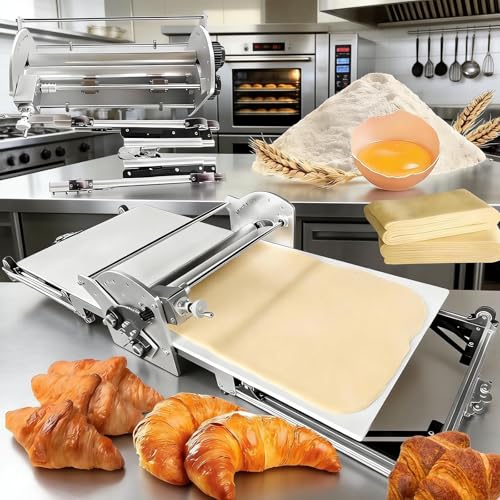
- 40-inch reversible conveyor supports even rolling
- 304 stainless steel contact surfaces simplify upkeep
- Foldable countertop design saves workspace
Best For: Home and small-business pastry production
Compact Commercial Workhorse
22.7-Inch Electric Dough Sheeter

- 2–30 mm adjustment suits varied dough recipes
- 304 stainless steel construction is food-safe
- Foldable countertop format saves storage space
Best For: Small commercial kitchens needing versatile dough rolling
Best Compact Pizza Roller
Automatic Dual-Roller Pizza Sheeter

- Automatic pressing for 4- to 12-inch pizza dough
- 0.03- to 0.21-inch adjustable thickness
- Overload protection and clear safety cover
Best For: Pizza-focused kitchens needing consistent automated dough pressing
Best Foldable Countertop Model
Adjustable Commercial Dough Sheeter

- 2-30mm thickness adjustment
- Handles pizza, pastry, pasta, and laminated dough
- Foldable design saves storage space
Best For: Multi-purpose baking setups with limited countertop room
Best Large-Capacity Sheeter
48-Inch Commercial Dough Roller

- 39.3-by-17.7-inch integrated rolling board
- 2-30mm adjustment for varied dough applications
- 30-pound capacity with stainless-steel construction
Best For: Commercial kitchens processing larger batches and varied pastries
Compact Pick
Foldable 22.7-Inch Electric Sheeter
- Foldable, detachable frame for compact storage
- Fine thickness adjustment for varied dough recipes
- Stainless steel rollers and frame with rolling wheels
Best For: Home bakers and small bakeries with limited storage
Heavy-Duty Choice

- Automatic rolling reduces manual preparation work
- Stainless steel body with food-grade PE board
- Adjustable thickness for pastries, pizza, fondant, and pasta
Best For: Frequent home or commercial baking
Versatile Pick
Foldable 2–30mm Dough Laminator

- Electric rolling helps reduce manual fatigue
- 2–30mm adjustment suits many dough types
- Detachable build, non-slip base, and washable plates
Best For: Mixed home and small-business baking tasks
High-Volume Pressing – VEVOR 18-Inch Electric Dough Sheeter
For busy pizza shops and tortilla operations, this electric dough sheeter is built around fast, repeatable pressing rather than traditional rolling. Its 18-inch capacity, adjustable thickness, temperature, and timer controls make it suitable for consistent crusts and flatbreads during demanding prep periods.
Best For: Pizza shops, tortilla restaurants, and other commercial kitchens handling frequent, high-volume dough production.
Pros:
- Presses dough into uniform crusts and can help speed up high-volume production.
- Handles dough products up to 18 inches, including pizza crusts, tortillas, burritos, pita, and focaccia.
- Offers 0–0.43-inch thickness adjustment plus adjustable temperature and timer settings.
- Steel construction, powder-coated finish, stainless steel handle, and cast aluminum press plate support frequent use.
Cons:
- At 112.4 pounds, it is substantially heavier than the foldable countertop sheeters in this roundup.
- Its press-focused design may be less suitable for users primarily making long, thin pastry sheets.
This is the most production-oriented option here for operators who need repeatable flatbreads and pizza crusts. Choose it when pressing speed, broad temperature control, and durability matter more than portability.
Flexible Countertop Rolling – WantJoin 40-Inch Electric Dough Sheeter
This electric dough sheeter uses a reciprocating motor to reduce manual rolling while accommodating dough up to 450 mm wide. Its broad food-grade PP board, 2–30 mm thickness range, foldable frame, and included croissant cutter make it a practical choice for varied pastry work.
Best For: Home bakers, small bakeries, and pastry shops preparing croissants, puff pastry, pie crusts, and pizza bases.
Pros:
- Electric left-right reciprocating operation helps reduce manual effort.
- Offers a 40-inch rolling surface for larger batches and dough up to 450 mm wide.
- Provides 2–30 mm thickness adjustment for gradual, controlled thinning.
- Foldable support frame, food-grade PP board, included croissant cutter, and one-year warranty add convenience.
Cons:
- Its 80W motor and home/small-commercial positioning may not suit heavy industrial production.
- The 42.1-pound weight still requires a suitable counter or storage area despite the foldable design.
WantJoin balances working width and storage convenience well. It is a strong fit when you want electric assistance for pastry sheets without committing to a large, fixed bakery machine.
Stainless Steel Value – Foldable 40-Inch Electric Dough Sheeter
For users comparing electric dough sheeters for home baking or small-business production, this model combines a 40 x 17.7-inch reversible conveyor with forward and reverse operation. Its 2–30 mm adjustment and 304 stainless steel contact surfaces support a range of dough types while the foldable design helps conserve workspace.
Best For: Home bakers, cafés, food trucks, pizzerias, and small bakeries making pastry, pizza, pie, pasta, or Danish dough.
Pros:
- Reversible conveyor supports even rolling and repeated forward/reverse operation.
- 2–30 mm thickness range accommodates thin pastry sheets and thicker pizza or bread dough.
- 304 stainless steel food-contact surfaces are designed for easier cleaning and hygienic handling.
- Foldable countertop structure helps save space in compact work areas.
Cons:
- The supplied product dimensions appear unusually small compared with its stated 40-inch conveyor, so buyers should verify the listing details.
- The notes do not specify a warranty or included cutter accessory.
This model is appealing for small-batch users who want a wide working surface and stainless steel contact areas in a foldable format. Confirm the dimensions before ordering, especially if available counter space is limited.
Compact Commercial Workhorse – 22.7-Inch Electric Dough Sheeter
This electric dough sheeter is designed for bakery and pizza-shop tasks while retaining a foldable countertop format. The 2–30 mm adjustment, 304 stainless steel construction, and front-load configuration make it suitable for preparing consistent sheets with less manual effort.
Best For: Bakeries, pizza shops, restaurants, and home kitchens that need adjustable rolling with a space-conscious setup.
Pros:
- Supports dough rolling for pizza, croissants, puff pastry, pasta, and empanadas.
- 2–30 mm thickness adjustment helps accommodate different recipes.
- 304 stainless steel construction is food-safe, rust-resistant, and intended for easier cleaning.
- Foldable countertop design helps reduce storage and workspace demands.
Cons:
- Its listed 22-inch working designation is narrower than the 40-inch models in this roundup.
- At 52 pounds, it is not especially lightweight for a foldable countertop machine.
- The supplied notes do not specify a warranty or rolling speed.
This option suits buyers who want commercial-style dough handling and stainless steel construction without a permanent production-line setup. Its narrower format may be easier to place, though it offers less stated working width than the larger alternatives.
Best Compact Pizza Roller – Automatic Dual-Roller Pizza Sheeter
For shoppers comparing electric dough sheeters for pizza preparation, this 370W Bepritm model focuses on automatic round forming, adjustable thickness, and a relatively compact roller setup. Its dual rollers handle 4- to 12-inch pizza dough, while the stainless-steel construction suits frequent countertop use.
Best For: Home kitchens, small food businesses, and pizza-focused operations that want automated dough pressing with adjustable thickness.
Pros:
- Dual-roller design can reduce reworking and improve production efficiency.
- Adjustable roller spacing supports dough thicknesses from 0.03 to 0.21 inches.
- Automatic dough-direction rotation and a clear safety cover simplify operation.
- Overload protection and rear ventilation help protect the motor during use.
Cons:
- Its stated 4- to 12-inch pizza range is narrower than the larger sheeters in this roundup.
- At 37.1 pounds, it may be cumbersome to move regularly.
- The design is specialized toward round pizza dough rather than a broad range of pastry formats.
This is a practical choice when pizza consistency and automated pressing matter more than maximum work-surface size. The adjustable settings and safety features add versatility, while the dual-roller format keeps the machine focused and straightforward.
Best Foldable Countertop Model – Adjustable Commercial Dough Sheeter
This commercial electric dough sheeter is designed for buyers who need flexible preparation without permanently giving up countertop space. It offers 2-30mm thickness adjustment for pizza, pastry, pasta, and laminated dough, plus a foldable design for easier storage.
Best For: Bakeries, pizza shops, restaurants, and home bakers who need one machine for multiple dough types and convenient storage.
Pros:
- Broad 2-30mm adjustment range supports both thinner and thicker dough applications.
- Suitable for pizza dough, croissants, puff pastry, fresh pasta, and empanadas.
- Foldable construction helps reduce countertop clutter when not in use.
- 304 stainless steel is food-safe, rust-resistant, and easy to clean.
Cons:
- The notes do not provide a specific motor wattage or stated dough capacity.
- Its 22.7-inch size may still require substantial counter or storage space.
- It may offer less specialized pizza forming than a dedicated pizza roller.
Among electric dough sheeters, this model stands out for versatility and storage convenience. The wide thickness range makes it useful across a bakery menu, while the foldable format is helpful for kitchens that need equipment to serve more than one role.
Best Large-Capacity Sheeter – 48-Inch Commercial Dough Roller
For professional kitchens needing a broad rolling surface, this 48-inch commercial electric dough sheeter combines a 2-30mm adjustment range with a food-grade PE rolling board. Its heavy-duty stainless-steel body and 30-pound stated capacity make it suited to regular bakery and pastry production.
Best For: Bakeries, pastry shops, cafés, and other commercial operations handling larger batches and varied dough styles.
Pros:
- Large 39.3-by-17.7-inch rolling board provides substantial working space.
- 2-30mm thickness adjustment accommodates croissants, pizza, puff pastry, cookies, pasta, fondant, and gum paste.
- Food-grade PE board offers a non-stick surface for easier release and cleanup.
- Detachable construction supports tool-free assembly, disassembly, and storage.
Cons:
- The 48-by-22.7-by-8.6-inch unfolded footprint is demanding for smaller kitchens.
- Its larger commercial format may be excessive for occasional home baking.
- The supplied notes do not specify the motor wattage or operating speed.
This is the strongest fit when workspace and batch capacity take priority. It offers the broad application range expected from commercial electric dough sheeters, but buyers should confirm that their kitchen can accommodate its sizable unfolded dimensions.
Compact Pick – Foldable 22.7-Inch Electric Sheeter
For home bakers and small bakeries comparing electric dough sheeters, this model emphasizes compact storage, adjustable roller clearance, and a food-grade stainless steel construction. Its foldable, detachable frame and rolling wheels make it practical when counter space is limited.
Best For: Home baking rooms, dessert shops, and small bakeries that need a movable, space-conscious sheeter.
Pros:
- Foldable and removable frame supports compact storage.
- Fine-tuning knob adjusts dough thickness for pastries, pizza bases, cookies, and bread crusts.
- Food-grade stainless steel rollers and frame are rust-resistant and easy to wipe clean.
- US-standard plug adapter provides a steady DC drive for desktop use.
Cons:
- The listed 22.7-inch size still requires substantial operating space.
- The supplied details do not specify an exact thickness range.
This is a sensible electric dough sheeter for buyers who prioritize storage flexibility and straightforward countertop operation over a fully specified commercial feature set.
Heavy-Duty Choice – Automatic 110V Dough Sheeter
This electric dough sheeter is aimed at users who want automatic rolling with a sturdy stainless steel body and a broad adjustable thickness range. Its food-grade PE rolling board and washable, disassemblable components suit frequent pastry preparation in home or commercial settings.
Best For: Bakeries, pastry shops, cafés, and serious home bakers needing automatic operation and versatile thickness control.
Pros:
- Fully automatic operation reduces manual rolling effort and preparation time.
- Adjustable thickness is listed from 2 to 30mm for tart shells, croissant dough, pizza, and more.
- Stainless steel construction is rust-resistant and designed for daily use.
- Non-stick PE/PP plates are washable and intended to simplify cleanup.
Cons:
- At 25 pounds, it is less convenient to move than lighter countertop models.
- The title states 0–25mm while the feature notes state 2–30mm, so the listed range should be verified.
- Its commercial-oriented construction may be more machine than occasional users need.
With automatic operation, substantial construction, and broad recipe versatility, this model is a strong option when consistent throughput matters more than minimum weight or footprint.
Versatile Pick – Foldable 2–30mm Dough Laminator
Among electric dough sheeters, this foldable model stands out for combining a 2–30mm adjustment range with detachable construction and a non-slip base. It is designed to handle laminated dough as well as cookie, pasta, pizza, fondant, and other preparations.
Best For: Home kitchens, cafés, and restaurants that need one adjustable machine for varied dough projects.
Pros:
- Electric operation delivers smooth, even rolling while reducing manual fatigue.
- 2–30mm thickness adjustment accommodates thin and thick dough applications.
- Detachable design helps with storage, while the non-slip base supports stability.
- Stainless steel body and washable PP/PE plates simplify routine maintenance.
Cons:
- The 48-inch depth dimension indicates that it needs considerable room when set up.
- The supplied notes do not provide detailed motor or speed specifications.
This is a practical all-rounder for buyers who want recipe flexibility and easier storage, especially when the machine will be used for more than croissants and puff pastry.
How We Picked the Best Electric Dough Sheeters
We focused on the features that matter most during repeated dough preparation: working width, thickness adjustment, motorized roller operation, forward and reverse controls, construction, and overall practicality. Models with stainless-steel surfaces, non-stick boards, foldable frames, or broad adjustment ranges can offer useful advantages, but the best choice still depends on the dough types and batch sizes you handle.
Because listed specifications can vary by seller or configuration, verify voltage, dimensions, included accessories, and maximum dough capacity before ordering. A suitable electrical circuit and enough clearance around the rollers are also essential.
Quick Comparison
| What to compare | Why it matters |
|---|---|
| Roller width | Determines the maximum practical dough sheet size and countertop footprint. |
| Thickness range | Shows whether the machine suits pizza, pasta, pastry, fondant, or laminated dough. |
| Reversible operation | Helps move dough through the rollers and can simplify repeated passes. |
| Construction | Stainless steel is generally easier to sanitize and suited to frequent use. |
| Foldable design | Useful when storage space is limited or the machine is moved between tasks. |
Key Buying Factors for Electric Dough Sheeters
Width and Workspace
Wider machines handle larger sheets but require more counter depth and clearance. Measure the complete operating area, including room for dough boards, trays, and the operator.
Thickness Control
Choose a broad, clearly marked adjustment range if you make several products. Fine control is particularly useful for pastry and fondant, while pizza dough users may prioritize throughput and roller width.
Power and Controls
Check the voltage before purchase, especially for commercial 110V models. Automatic forward/reverse operation can reduce handling, but confirm that controls are accessible and simple to use during production.
Cleaning and Durability
Look for food-contact surfaces that are easy to wipe down and inspect. Avoid forcing sticky or oversized dough through the rollers, and follow the manufacturer’s cleaning and lubrication instructions.
Who Should Buy Which Electric Dough Sheeters?
Home bakers and small kitchens: Choose a foldable or narrower unit that fits your storage area and supports the thicknesses you use most often.
Pizza-focused operators: Prioritize a suitable roller width, steady motorized feeding, and controls that support repeated dough passes.
Pastry and fondant users: Favor precise thickness adjustment, smooth surfaces, and a wide range that accommodates both thin sheets and thicker dough.
Busy bakeries: Look for robust stainless-steel construction, a comfortable working width, reversible operation, and a motor rated for your expected workload. Always confirm capacity and duty-cycle guidance before relying on a machine for continuous commercial production.