Making tomato sauce by hand can turn a productive harvest into an all-day project. The best electric tomato presses separate skins and seeds quickly while producing a smooth base for sauces, soups, salsas, and preserves.
We selected 10 models ranging from compact home machines to higher-capacity stainless-steel units. Use the comparison and buying advice below to match motor power, throughput, construction, and cleanup requirements to your kitchen or garden workload.
Best 10 Electric Tomato Presses Picks for 2026
Best for Italian-Style Batches
Reber N.3 450W Tomato Strainer

- 450W induction motor for continuous operation
- Processes up to 309 lb of tomatoes per hour
- Durable cast iron and stainless steel construction
Best For: Large home batches and Italian-style sauce making
Best Compact Masticating Design

- Up to 330 lb of tomatoes per hour
- 110 RPM masticating-style auger
- Die-cast housing with stainless steel hopper
Best For: Compact, high-throughput puree production
Best for Versatile Home Preserving

- Includes three stainless steel screens
- Two-speed motor with reverse function
- One-gallon hopper for home batches
Best For: Canning, sauces, jams, salsa, and mixed produce
Best High-Volume Performer
Reber N.5 650W Tomato Strainer

- 650W induction motor for heavy-duty use
- Up to 772 lb of output per hour
- All-metal gears and stainless steel parts
Best For: Very large harvests and demanding preserve production
High-Capacity Pick
COSTWAY 450W Electric Tomato Strainer
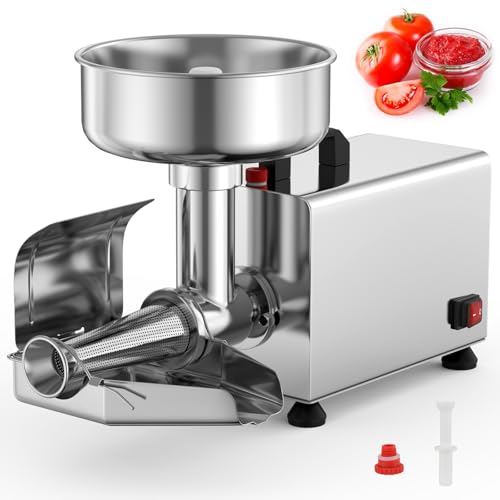
- Claims 200–350 lb/h processing capacity
- 304 stainless-steel body and detachable parts
- Safety guard, pusher, and anti-slip feet
Best For: Large-batch sauces, jams, and fruit processing
Most Versatile Kit
Johnny Apple Sauce Maker Model 250

- Includes four screens for varied produce
- Electric motor plus hand-crank option
- Five-year warranty and clamp mounting
Best For: Multi-purpose home purees, sauces, jams, and juices
Multi-Function Option
AIRMSEN Electric Meat Grinder and Tomato Press

- Combines tomato pressing with three other functions
- Includes tomato strainer and three grinding plates
- Reverse function and safety-lock design
Best For: Home kitchens needing tomato processing plus meat and sausage tools
Best Flexible Pick

- Electric motor and hand-crank operation
- 1.3 mm screen separates skins and seeds
- Clamps to countertops 3/4–2-1/8 inches thick
Best For: Versatile home sauce, puree, juice, and jam preparation
Best for Large Batches
VEVOR Electric Tomato Strainer

- 370W motor for high-volume processing
- Processes up to 200 pounds per hour
- Large hopper and tool-free disassembly
Best For: Bulk sauce making and harvest-season canning
Best Commercial-Style Build

- 304 stainless steel food-contact components
- 370W pure copper motor
- 9-inch funnel with adjustable trough
Best For: Repeated tomato and fruit-sauce processing
Best for Italian-Style Batches – Reber N.3 450W Tomato Strainer
Among electric tomato presses, the Reber N.3 stands out for continuous operation, durable construction, and a stated capacity of up to 309 pounds per hour. Its stainless steel processing parts and 450W induction motor make it a practical choice for sauces, preserves, jams, and fruit juices.
Best For: Home cooks processing substantial garden harvests who want an Italian-made machine with optional kitchen attachments.
Pros:
- 450W induction motor supports continuous operation.
- Processes up to 309 pounds of tomatoes per hour.
- Cast iron body and stainless steel AISI 304 components are built for durability.
- Optional attachments can expand its use beyond tomato straining.
Cons:
- At 21 pounds, it is relatively heavy for a countertop appliance.
- Hand-wash care may require extra cleanup time.
- Optional accessories are needed for functions beyond straining.
The Reber N.3 is a strong middle-ground option for frequent sauce making. It offers substantial throughput and robust materials without moving to the larger N.5 model.
Best Compact Masticating Design – OMRA Spremy 850
The OMRA Spremy 850 is one of the more compact electric tomato presses in this roundup. Its 1/4 HP motor and 110 RPM masticating-style auger are designed to separate puree from skins and seeds while handling fresh or cooked tomatoes at up to 330 pounds per hour.
Best For: Shoppers seeking a compact, Italian-made tomato strainer for high-throughput puree production.
Pros:
- Rated production reaches up to 330 pounds per hour.
- Masticating-style 110 RPM auger processes tomatoes at a slower rotation.
- Die-cast metal housing and stainless steel hopper provide sturdy construction.
- Cooling fan supports the 1/4 HP motor.
Cons:
- The listed voltage is 220 volts, so compatibility should be checked before buying.
- Supplied notes do not list multiple screens or optional attachments.
- The compact design may offer less capacity than larger commercial-style models.
The OMRA Spremy 850 combines a small footprint with an impressive stated processing rate. Confirm the electrical requirements first, especially if your household uses standard 120-volt outlets.
Best for Versatile Home Preserving – Weston Deluxe Tomato Strainer
The Weston Deluxe is a practical choice among electric tomato presses for home canning and preserving. Its 250W, two-speed motor, one-gallon hopper, reverse function, and three included screens support sauces, purees, jellies, salsa, and other soft produce.
Best For: Home gardeners and preservers who want screen-size flexibility and straightforward 120-volt operation.
Pros:
- Three stainless steel screens support fine, medium, and chunky preparations.
- Two speeds include reverse to help prevent jamming.
- One-gallon hopper suits larger home batches.
- Includes a stomper for feeding produce safely.
Cons:
- Its 250W motor is less powerful than the Reber models in this roundup.
- Plastic construction may feel less heavy-duty than cast-iron alternatives.
- The supplied notes do not state a pounds-per-hour processing capacity.
With useful accessories included, the Weston offers flexibility without requiring additional screens. It is particularly appealing for households making several types of preserves rather than tomato sauce alone.
Best High-Volume Performer – Reber N.5 650W Tomato Strainer
For demanding workloads, the Reber N.5 is the high-capacity choice among these electric tomato presses. Its 650W induction motor is rated for continuous operation and output of up to 772 pounds per hour, while its metal gears and stainless steel components are designed for heavy-duty sauce and preserve production.
Best For: High-volume processing of tomatoes, jams, and fruit juices where throughput and rugged construction matter most.
Pros:
- 650W induction motor supports heavy-duty continuous use.
- Stated output reaches up to 772 pounds per hour.
- All-metal gears and cast iron body emphasize durability.
- Stainless steel filter cone, funnel, and drip tray are included.
Cons:
- Its larger size may require substantial storage or counter space.
- Hand-wash care can make cleanup more involved.
- Optional attachments are required for additional kitchen functions.
The Reber N.5 is best suited to buyers who will regularly process very large quantities. Its capacity and heavy-duty design may be more machine than occasional home users need.
High-Capacity Pick – COSTWAY 450W Electric Tomato Strainer
If you need electric tomato presses for substantial batches, the COSTWAY is built around throughput. Its 450W motor, large feed chute, stainless-steel construction, and claimed 200–350-pound-per-hour capacity make it a commercial-style option for sauces, jams, and fruit processing.
Best For: Large-batch tomato sauce, jam making, and users who prioritize capacity and easy disassembly.
Pros:
- Claims processing capacity of 200–350 pounds per hour.
- Food-grade 304 stainless-steel construction with tool-free disassembly.
- Detachable parts are dishwasher-safe, according to the supplied notes.
- Includes safety features such as a motor guard, insulated switch, pusher, and anti-slip feet.
Cons:
- At 22 pounds and 20.5 inches deep, it requires substantial storage space.
- Its commercial-style capacity may be more than needed for occasional home batches.
The COSTWAY stands out among electric tomato presses when speed and batch size matter most. Its larger footprint and heavier build are tradeoffs, but the stainless-steel design and safety-focused features support frequent sauce-making.
Most Versatile Kit – Johnny Apple Sauce Maker Model 250
The Johnny Apple Sauce Maker is a flexible choice among electric tomato presses because it combines an electric motor with a clamp-mounted strainer and multiple screens. It can separate skins and seeds for tomato sauce while also handling purees, jams, juices, soups, and baby foods.
Best For: Home cooks who want one strainer for tomatoes, apples, berries, pumpkin, salsa, and other produce.
Pros:
- Includes berry, apple/tomato, pumpkin, and salsa screens.
- Electric motor can be swapped for the included hand crank.
- Clamp mount fits countertops from 3/4 to 2-1/8 inches thick.
- Includes a stated five-year warranty and BPA-free plastic components.
Cons:
- Clamp mounting requires a suitable countertop edge and setup space.
- Its 8-pound design is less oriented toward high-volume commercial processing than larger machines.
This model is appealing for households that value versatility over maximum throughput. The interchangeable screens and manual backup give it broader use across recipes, while the clamp system provides a secure countertop foundation.
Multi-Function Option – AIRMSEN Electric Meat Grinder and Tomato Press
For shoppers comparing electric tomato presses with broader kitchen appliances, the AIRMSEN combines tomato sauce processing with meat grinding, sausage making, and kibbeh preparation. Its included tomato strainer kit and reverse function add flexibility, although cleanup requires hand washing.
Best For: Home cooks who want tomato pressing alongside meat grinding and sausage-making functions.
Pros:
- Four-in-one design covers meat grinding, sausage, kibbeh, and tomato sauce processing.
- Includes a tomato strainer kit and three grinding plates.
- Reverse function helps clear jams, while rubber feet improve stability.
- Detachable components and a safety-lock knob support straightforward operation.
Cons:
- Supplied notes specify that the parts are not dishwasher-safe.
- It is a combination meat grinder rather than a dedicated tomato press.
- The notes list 300 watts despite a 2500W peak-power description, so buyers should verify the exact electrical specifications.
The AIRMSEN makes sense when tomato sauce is only one part of your kitchen routine. Its attachments broaden its usefulness, but shoppers seeking the simplest cleanup or a dedicated high-volume press may prefer a purpose-built model.
Best Flexible Pick – Johnny Apple Sauce Maker
If you want electric tomato presses that can handle more than sauce, this Johnny Apple Sauce Maker combines a hand crank with an included electric motor. Its 1.3 mm screen is designed to separate skins and seeds for sauces, purees, juices, jams, and other preparations.
Best For: Home cooks who want a versatile countertop strainer for small- to medium-size batches and multiple types of produce.
Pros:
- Includes an electric motor plus a hand-crank option.
- Separates skins and seeds with the included 1.3 mm apple/tomato screen.
- Cast aluminum body and stainless steel screens support repeated use.
- Clamp fits countertops from 3/4 to 2-1/8 inches thick.
Cons:
- Its clamp-based design requires a suitable countertop edge.
- The listed 1.3 mm screen may not suit every desired texture.
- It is less clearly aimed at high-volume processing than the commercial-style machines below.
This is a practical choice when versatility matters more than maximum throughput. The motor reduces manual effort, while the hand-crank option adds flexibility for different batches or situations.
Best for Large Batches – VEVOR Electric Tomato Strainer
For shoppers comparing electric tomato presses for harvest-season canning, the VEVOR Electric Tomato Strainer pairs a 370W motor with a large hopper and stainless steel components. It is designed to separate peels and seeds in a single pass while processing larger batches efficiently.
Best For: Bulk tomato processing, sauce making, and frequent canning where capacity and reduced manual work are priorities.
Pros:
- 370W motor is designed for high-volume sauce processing.
- Listed capacity reaches up to 200 pounds per hour.
- Large hopper reduces the need for frequent refills.
- Core parts disassemble without tools for easier cleaning.
Cons:
- Tomatoes should be cut into smaller pieces to help reduce clogging.
- At 21.7 pounds, it is a substantial machine to move and store.
- Its commercial-style design may be more capacity than occasional users need.
The VEVOR stands out for throughput and cleanup convenience. Its stainless steel food-contact components and large hopper make it a strong fit for users processing substantial quantities during harvest season.
Best Commercial-Style Build – VBENLEM 370W Tomato Strainer
Among electric tomato presses, the VBENLEM 370W Tomato Strainer emphasizes durable construction and steady commercial-style processing. Its 304 stainless steel food-contact parts, 9-inch funnel, and adjustable trough are designed for sauces, ketchup, and fruit-based preparations.
Best For: Users who want a sturdy 110V machine for repeated tomato and fruit-sauce processing.
Pros:
- Food-contact components are made from 304 stainless steel.
- 370W pure copper motor is enclosed in a stainless steel casing.
- 9-inch funnel supports feeding larger amounts of produce.
- Adjustable trough helps direct sauce and reduce splashing.
Cons:
- It requires a 110V power connection.
- The 22-pound body may be cumbersome to reposition.
- Produce processing may require adequate workspace for its roughly 19.3-by-9.1-by-13.6-inch footprint.
This model is a sensible match for frequent users who value stainless steel construction and a more controlled discharge setup. Its large funnel and adjustable trough add convenience when processing sauces in repeated batches.
How We Picked the Best Electric Tomato Presses
We compared these Electric Tomato Presses by looking at motor power, stated processing capacity, construction, feed-tube and hopper design, auger and screen materials, ease of assembly, cleaning, and overall suitability for home or small-scale batch processing. We also considered whether each model is designed primarily for tomatoes or can handle other soft produce such as apples, grapes, berries, and cooked vegetables.
Published capacity figures are useful for comparison, but actual output depends on tomato variety, ripeness, preparation, feeding speed, and how often the machine needs to be cleared. Treat commercial-grade claims as a guide rather than a guarantee of continuous real-world throughput.
Quick Comparison
| Best For | What to Prioritize |
|---|---|
| Occasional home batches | Compact size, simple controls, and easy cleanup |
| Large garden harvests | Higher wattage, durable components, and a generous hopper |
| Frequent sauce production | Reliable construction, cooling performance, and replacement parts |
| Multiple produce types | Interchangeable screens and a versatile food-mill design |
| Limited counter space | A clamp-based or compact model with manageable storage |
Key Buying Factors for Electric Tomato Presses
Motor Power and Processing Capacity
Higher wattage can help a press maintain performance during long batches or with dense produce, but wattage alone does not determine output. Compare the motor rating with the manufacturer’s stated pounds-per-hour or kilograms-per-hour capacity, and choose conservatively if you process large harvests.
Materials and Durability
Stainless-steel components are generally preferable for parts that contact acidic tomato juice, while sturdy food-safe plastic can keep a machine lighter and less expensive. Check the auger, screen, chute, clamps, and housing for signs of solid construction. If replacement screens or augers are available, long-term ownership is usually easier.
Screen Design and Texture
The screen controls how efficiently skins and seeds are separated and influences the texture of the finished puree. A well-designed screen should produce consistent pulp without excessive clogging. Models with additional screens offer more flexibility for different fruits and preparations.
Cleanup and Storage
Look for removable food-contact parts, straightforward disassembly, and components that can be rinsed without trapping pulp. A machine that is difficult to clean may be less useful during a busy harvest. Also measure your counter and storage space before choosing a larger commercial-style unit.
Safety and Operating Requirements
Confirm the voltage, plug type, grounding requirements, and recommended operating cycle before buying. Never force produce into the hopper with your hands; use the supplied pusher and follow the manufacturer’s instructions for hot ingredients, if hot processing is permitted.
Who Should Buy Which Electric Tomato Presses?
Choose a compact or clamp-mounted press if you make sauce only a few times per year, have limited storage, or want a straightforward setup. A midrange electric model is a better fit for gardeners processing several boxes of tomatoes and wanting a balance of speed, capacity, and cleanup.
For frequent preserving, community harvests, or large seasonal batches, prioritize the higher-capacity Reber, OMRA, COSTWAY, VEVOR, or VBENLEM-style machines, while checking their voltage and actual footprint. A versatile Weston, Johnny Apple, or AIRMSEN-style food mill may be preferable if you also plan to process apples, salsa ingredients, pumpkin, or other soft produce. Whichever model you choose, buy enough capacity for your typical batch rather than relying solely on the highest advertised throughput.