Processing wheat, corn, rice, or other dry grains in quantity requires more than a basic countertop grinder. The best grain mills for large batches combine useful capacity, consistent output, durable construction, and controls that make extended milling manageable.
This roundup compares 10 electric and manual options for home bakers, homesteaders, and small farms. Use the buying guide below to match motor power, hopper size, milling control, and cleanup demands to your workload.
Best 10 Grain Mills for Large Batches Picks for 2026
High-Power Wet/Dry Workhorse

- 3000W motor for continuous grinding
- Handles dry grains and wet soybeans or rice
- Adjustable thickness with heavy-duty cast-iron build
Best For: Large-batch dry and wet grinding
Motorization-Ready Classic
Lehman's Diamant European Grain Mill
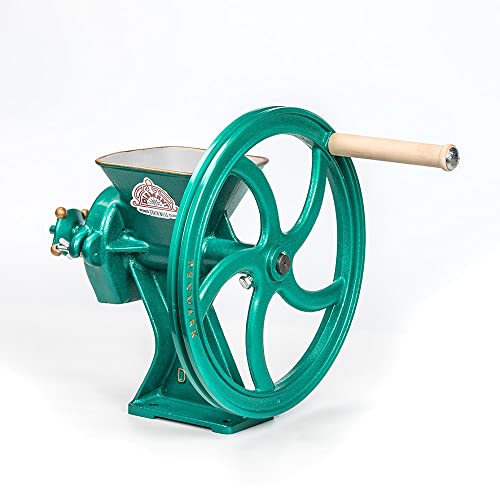
- Large iron burrs adjust from fine to coarse
- Handles grains, legumes, spices, nuts, and seeds
- Cast-iron flywheel can be motorized
Best For: Durable farm and baking use with upgrade flexibility
High-Capacity Hopper Mill

- 13.2-gallon capacity for substantial batches
- Five sieves provide 2–8 mm textures
- Continuous feeding with a 1000W motor
Best For: Dry grain and animal-feed processing
Compact Manual Option
Victoria 2400g Cast Iron Grain Mill

- Manual cast-iron mill with high hopper
- Clamps to tables 1/2–2 inches thick
- Versatile for grains, beans, spices, and seeds
Best For: Electricity-free small-to-moderate batches
Versatile Farm-Ready Grinder

- 25-liter capacity for larger batches
- Six sieves from 0.6 to 8 mm
- Removable hopper and bucket
Best For: Home and farm users milling dry grains and feed
Hand-Powered Workhorse
Lehman's Manual Power Grain Mill

- Six-cup hopper for fewer refills
- 12-inch flywheel eases hand grinding
- Can be motorized and bolted down
Best For: Manual milling and self-sufficient food preparation
High-Output Precision Mill
3000G Stainless Steel Grain Grinder

- 3,000-gram batch capacity
- 3,600W motor with 30-300 mesh output
- Overload protection and stainless steel body
Best For: Fast, fine milling of dry grains, spices, and coffee
Best Commercial Capacity

- 1000g stainless steel chamber for larger batches
- 3000W motor with speeds up to 32,000 RPM
- Adjustable 70–300 mesh powder control
Best For: Bulk dry-ingredient preparation in kitchens, bakeries, and restaurants
Best for Fresh Bread Flour

- 1200-watt motor handles hard grains like wheat
- 8-cup hopper and 12-cup flour canister
- Compact parts-nesting design aids storage
Best For: Frequent home bread bakers milling wheat into fine flour
Best Easy-Pour Design

- Tilting chamber simplifies powder transfer
- 750g capacity with a 2000W motor
- Includes sieve and cleaning tools
Best For: Dry-ingredient batch prep where easier handling matters
High-Power Wet/Dry Workhorse – 3000W Commercial Grain Mill
For grain mills for large batches, this VEVOR model emphasizes high power, continuous grinding, and flexible dry or wet processing. Its adjustable thickness control and funnel feed make it suited to users who need more than basic flour milling.
Best For: High-volume home, farm, or small food-production grinding where dry grains, wet soybeans, rice, and feed may all be processed.
Pros:
- Powerful 3000W motor is designed for high-capacity, continuous grinding.
- Supports both dry grinding and wet grinding with included discs.
- Adjustable thickness accommodates flour, cereal, spices, coffee, nuts, and corn.
- Heavy-duty cast-iron body and stainless-steel funnel are built for prolonged use.
Cons:
- Its industrial size and approximately 27.56-inch height require substantial space.
- Focused on powered operation rather than portability or manual use.
This is the most versatile large-batch option in the group, especially if wet grinding and feed preparation matter alongside flour production. Choose it when motor power and application range take priority over a compact countertop design.
Motorization-Ready Classic – Lehman's Diamant European Grain Mill
Among grain mills for large batches, the Lehman’s Diamant stands out for its oversized burrs, substantial cast-iron construction, and ability to be hand-turned or motorized. It is a strong fit for buyers who want one mill for household baking, farm use, and animal feed.
Best For: Serious home bakers, homesteaders, and farm users who value durable manual milling with the option to add motor power.
Pros:
- Large 5-1/4-inch iron burrs produce flour from powder-fine to coarse textures.
- Grinds grains, legumes, beans, spices, nuts other than peanuts, and seeds without changing burrs.
- Solid cast-iron flywheel adds momentum and supports smooth hand operation.
- Can be motorized through its 16-inch V-belt pulley.
Cons:
- At 56 pounds, it is heavy to move or store.
- Manual operation may require more effort for sustained large batches unless motorized.
- Hand-wash care may add cleanup time.
The Diamant is a durable, adaptable choice for buyers who want long-term versatility rather than a plug-in appliance. Its motorization capability makes it especially appealing when batch sizes may grow over time.
High-Capacity Hopper Mill – 50L Electric Corn Grinder
This 50-liter electric mill is designed for grain mills for large batches, with a tall hopper, collection barrel, and the ability to keep feeding grain while it runs. Five sieve sizes provide useful control over the finished texture for flour, meal, and animal feed.
Best For: Farm and home users processing substantial quantities of dry corn and grain into several coarseness levels.
Pros:
- Large 13.2-gallon capacity supports extended batch preparation.
- Five included sieve sizes range from 2 to 8 mm for different textures.
- 1000W copper motor runs at up to 19,000 rpm for efficient grinding.
- Heat-sink openings support heat dissipation during operation.
Cons:
- Designed for dry grains; the supplied notes do not indicate wet-grinding capability.
- At nearly 36.81 inches tall, it needs significant vertical clearance.
- Plastic and galvanized-sheet construction may feel less heavy-duty than a cast-iron mill.
Its large hopper and continuous-feed design make it a practical batch processor, particularly for animal feed and coarser grain products. The interchangeable sieves are useful when one machine must cover several textures.
Compact Manual Option – Victoria 2400g Cast Iron Grain Mill
The Victoria 2400g is a manual alternative for shoppers comparing grain mills for large batches without adding a motor or electrical connection. Its high hopper, table clamp, and adjustable screw make it practical for small-to-moderate runs of corn, grains, beans, spices, and other ingredients.
Best For: Home users who want a compact, manually operated mill for versatile coarse-to-medium grinding.
Pros:
- Heavy-duty cast-iron construction includes erosion-resistant discs.
- High hopper and 2400g capacity support repeated loading.
- Clamps to tables from 1/2 to 2 inches thick, with a rubber protector for stability.
- Handles grains, coffee, seeds, nuts, spices, dried beans, and more.
Cons:
- It cannot produce a superfine texture or fine whole-wheat powder.
- Manual cranking is less efficient for very large batches than an electric mill.
- The product includes a 90-day limited manufacturer warranty.
This mill is best viewed as a versatile, space-conscious manual tool rather than a true high-throughput batch machine. It makes sense when electricity-free operation, table mounting, and straightforward cast-iron construction matter most.
Versatile Farm-Ready Grinder – 25L Electric Grain Mill
For shoppers comparing grain mills for large batches, this 25-liter electric model offers a practical option for home or farm use. It handles dry wheat, corn, soybeans, and similar materials, while six interchangeable sieves let you adjust the grind from 0.6 to 8 mm.
Best For: Home and farm users processing larger quantities of dry grains and feed materials.
Pros:
- 25-liter capacity supports larger batch processing.
- Six sieves provide multiple grinding sizes.
- Removable hopper and bucket simplify cleaning and storage.
- Materials can be fed continuously while grinding.
Cons:
- For dry materials only; moisture can damage or clog the grinder.
- Its 33.07-inch height may require dedicated storage space.
- Blade replacement requires careful handling.
Choose this model when capacity, adjustable sizing, and straightforward electric operation matter more than compact countertop storage. Its removable components and included replacement blade add useful practicality for repeated batch work.
Hand-Powered Workhorse – Lehman's Manual Power Grain Mill
For grain mills for large batches without relying on electricity, Lehman’s manual mill combines a six-cup hopper with a 12-inch flywheel. It grinds free-flowing dry grains such as wheat, corn, rye, rice, quinoa, and small beans, and it can also be motorized if your setup allows.
Best For: Self-sufficient users who want manual control and the option to motorize their mill.
Pros:
- Six-cup hopper reduces the need for constant refilling.
- Large 12-inch flywheel provides momentum for easier hand grinding.
- Stainless steel grinding burrs have a smooth, polished surface.
- Four pre-drilled base holes allow secure bolting.
Cons:
- Manual grinding requires physical effort and may be slower than electric milling.
- It is designed for free-flowing, dry grains only.
- At 14 inches high and 26 pounds, it is not especially lightweight.
This is a strong fit for buyers prioritizing durability, control, and off-grid flexibility. The flywheel makes hand operation more manageable, while the motorization option provides a path to higher throughput later.
High-Output Precision Mill – 3000G Stainless Steel Grain Grinder
Among grain mills for large batches, this 3,000-gram stainless steel grinder is geared toward fast processing of dry ingredients. Its 3,600W copper motor, 36,000 RPM speed, and 30-300 mesh range suit grains, spices, coffee, and other oil-free materials, with a stated three-minute cycle followed by a five-to-ten-minute cooldown.
Best For: Home bakers, small delis, and other users needing fast, fine dry-ingredient processing.
Pros:
- 3,000-gram capacity handles a substantial batch at once.
- High-speed motor supports fine powders from 30 to 300 mesh.
- Processes grains, spices, herbs, coffee, and other dry ingredients.
- Overload protection helps prevent motor burnout.
Cons:
- Requires a three-minute grinding cycle and five-to-ten-minute cooldown.
- Ingredients should be completely dry and fill the chamber no more than two-thirds.
- Cleaning is limited to wiping the chamber; the blades require careful handling.
This model makes the most sense when speed and fine, consistent results are priorities. Its capacity is useful for larger batches, but the duty cycle means sustained production requires planned pauses between runs.
Best Commercial Capacity – 1000g 3000W Grain Grinder
For shoppers comparing grain mills for large batches, this commercial-style grinder stands out with a 1000g stainless steel chamber and a 3000W motor. Its adjustable 70–300 mesh control supports everything from coarser particles to fine powder, though it is intended only for dry ingredients.
Best For: Home kitchens, bakeries, restaurants, and bulk preparation involving grains, spices, coffee, herbs, and other dry ingredients.
Pros:
- Large 1000g capacity helps reduce the number of grinding cycles.
- 3000W motor and 32,000 RPM speed support fast pulverizing.
- Adjustable 70–300 mesh settings offer flexible powder textures.
- Safety lock, automatic shut-off, and overload protection add convenience.
Cons:
- Not suitable for wet, oily, or sticky ingredients.
- Its 16.2-inch height may require substantial storage space.
This is the strongest capacity-focused option in the group. Choose it when larger dry-ingredient batches and fine texture control matter more than compact storage.
Best for Fresh Bread Flour – NutriMill Impact Compact
This NutriMill is a practical choice among grain mills for large batches, pairing a 1200-watt motor with an 8-cup hopper and 12-cup flour canister. Its impact milling heads are designed for fine-textured bread flour, while the compact nesting design helps simplify storage.
Best For: Frequent home bread bakers who want to mill hard grains such as wheat into consistent flour.
Pros:
- 1200-watt motor is designed to handle hard grains like wheat.
- 8-cup hopper and 12-cup canister support substantial batches.
- Impact milling heads target fine, consistent bread flour.
- Parts nest together for more convenient storage.
Cons:
- The supplied notes do not specify adjustable grind settings.
- Its stated capacity is smaller than the 1000g commercial-style grinder.
For bread-focused use, this model offers a more specialized setup than general-purpose pulverizers. Its hopper, canister, and compact storage design suit regular home baking routines.
Best Easy-Pour Design – 750g Swing-Type Grain Mill
If you need grain mills for large batches but also value easier handling, this swing-type grinder offers a 750g chamber that tilts for simpler powder transfer. The 2000W motor reaches 25,000 RPM and is suited to dry grains, coffee, spices, herbs, seeds, and similar ingredients.
Best For: Home kitchens, cafés, restaurants, and small food-prep spaces that need medium-large dry batches with easier pouring.
Pros:
- Swinging chamber makes finished powder easier to transfer.
- 750g capacity supports efficient batch preparation.
- 2000W motor and 25,000 RPM speed handle a broad range of dry ingredients.
- Includes a sieve, cleaning brush, and maintenance tools.
Cons:
- Operation is limited to cycles of no more than 3 minutes, followed by a 5–10 minute rest.
- Not suitable for wet, damp, moist, or oily ingredients.
- Its capacity is lower than the 1000g model.
This model balances useful batch capacity with a more convenient swing-out chamber. It is a good fit when transfer and handling are priorities, provided you can work within its required rest intervals.
How We Picked These Grain Mills for Large Batches
We focused on mills designed for repeated processing rather than occasional spice grinding. Key considerations included stated motor power, hopper or chamber capacity, milling range, construction materials, speed control, sieve options, and whether each model is better suited to flour, cracked grain, feed, or multipurpose grinding. Manual mills were included for buyers who value durability, emergency readiness, or independence from electricity.
Because manufacturers often describe capacity and output differently, treat advertised figures as starting points rather than guaranteed throughput. Actual performance varies with grain type, moisture, grind setting, and how continuously the machine can operate.
Quick Comparison
| Type | Best for | Main advantage | Trade-off |
|---|---|---|---|
| Heavy-duty electric | Frequent large batches | Fast processing with less physical effort | Noise, heat, and electrical requirements |
| High-capacity farm-style electric | Grain, feed, and coarse-to-fine work | Larger hoppers and sieve flexibility | Usually takes more storage space |
| Compact electric | Fresh flour and moderate batches | Smaller footprint and simple operation | Less suitable for nonstop production |
| Manual cast-iron | Off-grid or occasional milling | No motor, strong long-term durability | Slower and physically demanding |
Key Buying Factors for Grain Mills for Large Batches
Capacity and Throughput
Look beyond the headline wattage. A large hopper reduces refilling, while a stable feed mechanism and cooling design matter during extended sessions. For farm or feed use, verify that the mill is rated for the grains and volume you plan to process.
Grind Control
Adjustable settings or interchangeable sieves let one machine handle flour, meal, cracked grain, and some feed applications. Confirm that the finest setting is appropriate for your intended baking results; high speed alone does not guarantee fine flour.
Construction and Maintenance
Stainless steel and cast iron generally offer better durability than lightweight plastic components, but they can add weight. Check how easily the chamber, screens, and burrs or blades can be accessed for cleaning. Dry grain should be used unless the manufacturer specifically permits oily or damp ingredients.
Power, Noise, and Safety
High-powered models may need a suitable outlet and should not be run beyond their recommended duty cycle. Consider motor noise, vibration, thermal protection, grounding, lid locks, and overload instructions before setting up a permanent milling station.
Who Should Buy Which Grain Mills for Large Batches?
Choose a heavy-duty electric mill if you regularly process multiple containers of grain and want speed. A farm-style model with several sieve sizes is a better fit when you need both flour and animal feed. A compact electric grinder suits fresh flour for a household, provided your batches are moderate. Choose a manual cast-iron mill for backup power, long service life, or off-grid use, but expect substantially more effort and slower output.
Before ordering, compare the machine’s working capacity with your real batch size, measure available counter or floor space, and confirm warranty and replacement-part support. Those practical details often matter more than the highest advertised RPM or wattage.