Manual food strainer machines make it easier to process tomatoes, apples, berries, and cooked vegetables without laborious peeling or seed removal. The right model can help you prepare sauces, jams, purees, and baby food with less mess and more consistent results.
This roundup compares clamp-on strainers, rotary food mills, and motor-assisted designs, focusing on capacity, ease of use, versatility, cleanup, and the type of produce each machine handles best.
Best 10 Manual Food Strainer Machines Picks for 2026
Best Clamp-On Sauce Maker

- Clamp fits countertops 3/4–2-1/8 inches thick
- Includes 1.3 mm apple/tomato screen
- Handles sauces, purees, jams, and juices
Best For: Home cooks making sauces and preserves with a countertop-mounted strainer
Best Traditional Sauce Strainer
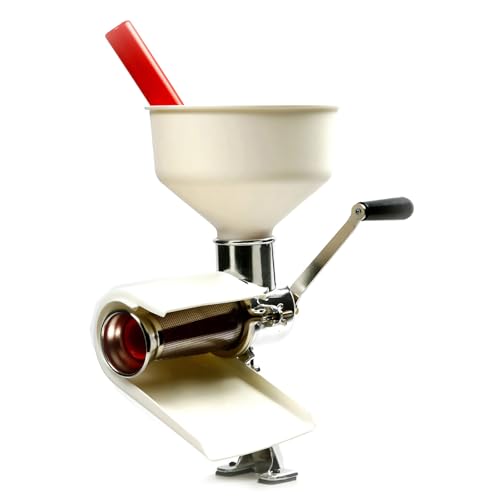
- 3-quart capacity for larger batches
- Separates juice and pulp in one operation
- Includes fine mesh screen and standard spiral
Best For: Batch sauce and puree preparation with expandable screen options
Best Suction-Mount Tomato Strainer

- Juices tomatoes without peeling or coring
- Separates skins and seeds to the side
- Includes stainless steel pusher and suction base
Best For: Fresh tomato juice, salsa, and homemade tomato sauces
Best Multi-Disc Food Mill
Hungry Artisan 4-Disc Food Mill

- Four discs provide broad texture control
- Stainless steel construction is dishwasher safe
- Support hooks help stabilize the mill over cookware
Best For: Versatile purees, sauces, mashed potatoes, jams, and preserving
Best Large-Batch Tomato Press
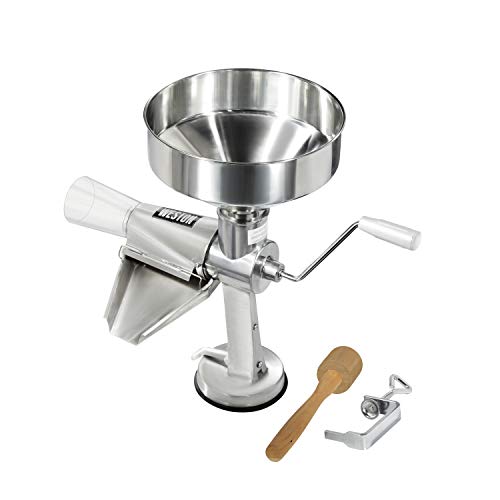
- One-gallon stainless steel hopper
- Dual suction-cup and C-clamp mounting
- Includes stomper and 1.5mm screen
Best For: Large batches of tomato sauce, jams, and fruit purees
Best Powered Food Strainer

- Includes hand crank and electric motor
- 1.3mm apple and tomato screen
- Clamp fits 3/4- to 2-1/8-inch countertops
Best For: Flexible sauce, juice, jam, and puree preparation
Best Versatile Food Mill
Stainless Steel Rotary Food Mill

- Three interchangeable milling discs
- Stainless steel, dishwasher-safe construction
- Dual hooks and silicone grip improve stability
Best For: Small-batch sauces, mashed potatoes, jams, and purees
Best Electric Batch Strainer
Weston Deluxe Electric Tomato Strainer

- 250-watt motor with forward and reverse speeds
- One-gallon hopper for larger batches
- Three stainless steel screens included
Best For: High-volume sauces, purees, and preserving
Best Manual Screen Variety

- Hand-crank design for manual processing
- Four screens for fine to chunky results
- Clamp fits countertops 3/4 to 2-1/8 inches thick
Best For: Versatile small-batch home processing
Best Manual-to-Electric Upgrade
Johnny Apple Sauce Maker with Motor

- Includes both hand crank and electric motor
- Four screens plus standard and grape spirals
- Five-year warranty and strong clamp mount
Best For: Flexible home processing with powered assistance
Best Clamp-On Sauce Maker – Johnny Apple Sauce Maker
For cooks comparing manual food strainer machines, the Johnny Apple Sauce Maker is a versatile clamp-on option for separating skins and seeds while making sauces, purees, jams, juices, and more. Its hand crank, included screen, and sturdy countertop clamp make it well suited to small- and medium-batch kitchen projects.
Best For: Homemade applesauce, tomato sauce, purees, jams, and other produce-based preparations.
Pros:
- Includes a 1.3 mm apple/tomato screen, standard spiral, and instructions.
- Clamp mounts to countertops from 3/4 to 2-1/8 inches thick.
- Can separate produce skins and seeds without requiring an electric motor.
- BPA-free plastic components and stainless steel screens support regular use.
Cons:
- Optional electric motor and specialty screens are sold separately.
- Clamp mounting requires a suitable countertop edge and available workspace.
This is a practical pick when secure countertop mounting and accessory expandability matter. The included screen focuses on fine sauces, while optional screens can broaden its preserving capabilities.
Best Traditional Sauce Strainer – Norpro 1951 Sauce Master
The Norpro 1951 Sauce Master is one of the straightforward manual food strainer machines for processing vegetables, fruits, and purees. It presses food through a chrome-plated steel screen while separating juice and pulp in one operation, with a stated 3-quart capacity.
Best For: Batch preparation of vegetable sauces, fruit purees, and similar strained foods.
Pros:
- Offers a 3-quart, or 95-ounce, capacity.
- Automatically separates juice and pulp during straining.
- Includes a fine mesh screen, standard spiral, recipe, and instruction booklet.
- Additional berry, pumpkin, and salsa screens are available separately.
Cons:
- Additional specialty screens require separate purchases.
- The listed dimensions are relatively substantial for a kitchen strainer.
Choose this model if you want a traditional sauce-making setup with useful capacity and a fine screen included. Its accessory screen options may appeal to cooks who plan to process different types of produce.
Best Suction-Mount Tomato Strainer – Tomato Strainer
Among manual food strainer machines, this tomato strainer is focused on convenient tomato juicing and pureeing. It ejects skins and seeds to the side while juice flows down the tray, and its suction-cup base is designed to keep the unit in place during use.
Best For: Fresh tomato juice, homemade salsa, pasta sauce, and tomato puree.
Pros:
- Processes tomatoes without peeling, coring, or deseeding first.
- Skins and seeds exit separately while juice runs into the tray.
- Includes a stainless steel pusher for guiding tomatoes through the mill.
- Suction-cup base helps secure the strainer during operation.
Cons:
- Its recommended uses are centered primarily on tomatoes.
- The construction is listed as plastic rather than stainless steel.
This is a focused choice for gardeners and farm-to-table cooks who mainly want to process fresh tomatoes. The compact design and suction mount emphasize convenience over broad accessory-based versatility.
Best Multi-Disc Food Mill – Hungry Artisan 4-Disc Food Mill
The Hungry Artisan 4-Disc Food Mill stands out among manual food strainer machines for its interchangeable stainless steel discs. Its manual rotary crank and bowl-supporting hooks are designed to provide texture control for purees, sauces, mashed potatoes, baby food, jams, and preserving projects.
Best For: Cooks who want several texture options for purees, sauces, mashed potatoes, jams, and canning.
Pros:
- Includes four interchangeable discs for fine, coarse, and ultra-fine results.
- Stainless steel construction is described as rust- and corrosion-resistant.
- Dishwasher-safe design simplifies cleanup.
- Double-welded support hooks help steady the mill over bowls and pots.
Cons:
- Manual crank operation can still require effort during large batches.
- Capacity and dimensions should be checked to ensure a suitable kitchen fit.
This model is a strong fit when texture flexibility is more important than a single-purpose tomato setup. Its four discs, ergonomic grip, and dishwasher-safe stainless steel construction support varied everyday and seasonal prep.
Best Large-Batch Tomato Press – Weston Metal Tomato Strainer
For shoppers comparing manual food strainer machines, the Weston Metal Tomato Strainer stands out with its one-gallon hopper and stainless steel construction. It separates skins and seeds from tomatoes and other soft produce without requiring peeling or coring, making it practical for sauces, salsas, jams, and purees.
Best For: Home cooks processing large batches of tomatoes, apples, and other soft fruits or vegetables.
Pros:
- One-gallon stainless steel hopper supports larger batches.
- Dual mounting system uses either a suction-cup base or C-clamp.
- Includes a stomper and 1.5mm multipurpose screen.
- Splash guard and directed chute help reduce mess.
Cons:
- Additional screens require a separate accessory kit.
- Designed for soft fruits and vegetables rather than general-purpose grinding.
The Weston is a strong choice when capacity and secure countertop mounting matter most. Its included screen handles common tomato and apple preparations, while optional screens expand its puree-making range.
Best Powered Food Strainer – Johnny Apple Sauce Maker
Among manual food strainer machines, the Johnny Apple Sauce Maker offers added flexibility because it can be operated by hand or with its included electric motor. Its 1.3mm screen separates skins and seeds for sauces, juices, jams, pie fillings, purees, and other soft-produce preparations.
Best For: Cooks who want the control of a hand crank with the option of electric-powered processing.
Pros:
- Includes both a hand crank and electric motor.
- Handles apples, tomatoes, fruits, and vegetables.
- Sturdy cast aluminum body with stainless steel screens.
- Clamp fits countertops from 3/4 to 2-1/8 inches thick.
Cons:
- Heavier and more involved than a basic hand-crank strainer.
- Uses a countertop clamp, so mounting depends on a compatible surface.
This model is a versatile pick for frequent sauce and puree preparation. The included motor can reduce manual effort, while the clamp-based design and 1.3mm screen provide a practical setup for countertop use.
Best Versatile Food Mill – Stainless Steel Rotary Food Mill
This stainless steel rotary mill is a compact alternative among manual food strainer machines, using interchangeable discs to process tomatoes, potatoes, fruits, and vegetables. Its dual hooks stabilize the mill over a bowl, while silicone-covered handles are intended to improve grip and comfort during turning.
Best For: Home cooks who want one hand-operated mill for sauces, mashed potatoes, jams, and soft produce.
Pros:
- Includes three milling discs with different pore sizes.
- Food-grade stainless steel construction is dishwasher safe.
- Dual hooks help secure the mill over a mixing bowl.
- Includes a multifunctional spoon for pressing and scraping.
Cons:
- Manual operation requires continuous turning.
- Its bowl-mounted design is less suited to very large batches.
The rotary food mill is a practical choice for cooks who value versatility over high-volume throughput. Three discs let you adjust texture for sauces, purees, and mashed foods, while the silicone grip and included spoon add convenience.
Best Electric Batch Strainer – Weston Deluxe Electric Tomato Strainer
For shoppers comparing manual food strainer machines but wanting faster batch processing, the Weston Deluxe Electric Tomato Strainer uses a 250-watt, two-speed motor to separate skins and seeds from soft produce. Its one-gallon hopper and three screens suit sauces, purees, jellies, salsa, and preserving projects.
Best For: Large batches of tomatoes, berries, vegetables, sauces, and preserved foods.
Pros:
- Processes produce with a powerful 250-watt motor and forward/reverse speeds.
- One-gallon hopper supports larger preserving batches.
- Includes 1.5mm, 3mm, and 6mm stainless steel screens for different textures.
- Stomper helps feed food safely into the hopper.
Cons:
- Requires an AC power connection rather than hand-crank operation.
- Its 14-by-12-by-17-inch size may require dedicated storage space.
The Weston is the strongest choice here for convenience and throughput. Choose it if reducing manual effort and handling substantial harvests matter more than having a compact hand-operated setup.
Best Manual Screen Variety – Johnny Apple Sauce Maker
This Johnny Apple Sauce Maker is a practical manual option for shoppers seeking manual food strainer machines with broad produce flexibility. Its hand crank, clamp mount, cast aluminum body, and four included screens support everything from berry sauces and tomato mixtures to pumpkin puree and chunky salsa.
Best For: Home cooks who want manual control and multiple screen sizes for varied recipes.
Pros:
- Includes berry, apple/tomato, pumpkin, and salsa screens.
- Clamp mounts to countertops from 3/4 to 2-1/8 inches thick.
- Cast aluminum body and stainless steel screens are designed for repeated use.
- Optional electric motor compatibility adds future flexibility.
Cons:
- Electric motor is optional and sold separately.
- Requires countertop clamping and hand-crank effort during use.
With four screens included and a substantial countertop clamp, this model is well suited to hands-on processing. It makes sense for buyers who value control, recipe variety, and a five-year warranty over powered operation.
Best Manual-to-Electric Upgrade – Johnny Apple Sauce Maker with Motor
For buyers comparing manual food strainer machines who want the option to reduce cranking, this Johnny Apple Sauce Maker includes an electric motor alongside its hand-crank design. Four screens, two spirals, and a sturdy clamp make it adaptable for sauces, juices, jams, purees, and other soft produce preparations.
Best For: Users who want both hands-on control and included powered operation.
Pros:
- Includes an electric motor while retaining hand-crank capability.
- Four screens cover berry, tomato, pumpkin, and salsa textures.
- Includes standard and grape spirals for different produce.
- Five-year warranty and a 10-square-inch clamp provide added ownership support and stability.
Cons:
- Its motor-equipped design is heavier than the hand-crank-only version.
- Still requires a suitable countertop for the clamp mount.
This is the most flexible Johnny model in the lineup because it includes both operating methods. Choose it if you want electric assistance for larger or more tiring batches without giving up manual control.
How We Picked These Manual Food Strainer Machines
We selected models that suit common home-processing tasks, including tomato sauce, applesauce, salsa, pumpkin puree, jams, and mashed vegetables. Our comparison emphasizes practical differences: manual effort, hopper size, material quality, stability, included screens or milling discs, and how easily each design separates skins and seeds.
Because these products use different mechanisms, we considered both traditional rotary food mills and clamp-based strainers. Some are fully manual, while others include electric assistance. That distinction matters when processing a large garden harvest or making only occasional small batches.
Quick Comparison
| Best For | Look For | Why It Matters |
|---|---|---|
| Small batches | Compact food mill or simple clamp model | Easy storage and quick setup |
| Tomato sauce | Dedicated strainer with a fine screen | Separates seeds and skins efficiently |
| Multiple recipes | Several discs or interchangeable screens | Handles sauces, jams, purees, and vegetables |
| Large harvests | Large hopper or motorized operation | Reduces hand cranking and processing time |
Key Buying Factors for Manual Food Strainer Machines
Straining Method
Clamp-based machines typically push produce through a screen while removing skins, seeds, and cores. Rotary food mills usually press cooked food through a perforated disc. Choose a dedicated strainer for frequent tomato or apple processing, or a multi-disc mill if you want broader kitchen versatility.
Capacity and Effort
A larger hopper can reduce refilling during harvest season, but it may require more counter space. Manual cranking is suitable for modest quantities; an electric motor is more practical for repeated or high-volume batches.
Construction and Stability
Stainless steel components resist staining and are generally well suited to acidic foods. Also check the clamp, base, handle, and mounting surface. A stable machine is safer and less tiring to operate than one that shifts while cranking.
Discs, Screens, and Cleanup
Fine screens produce smoother sauces, while wider or interchangeable discs offer more control over texture. Removable parts make rinsing easier, especially after thick tomato pulp or sticky fruit mixtures. Confirm which accessories are included rather than assuming every pictured component comes in the box.
Who Should Buy Which Manual Food Strainer Machines?
Choose a basic clamp-style strainer if you want an affordable tool for occasional applesauce, tomato sauce, or berry processing. A rotary food mill is the better fit for cooks who want one compact device for purees, mashed potatoes, jams, and sauces. Select a stainless steel or larger-hopper model for frequent canning and demanding batches. If you regularly process several gallons of produce, a motorized option can justify its higher cost by reducing hand fatigue and speeding up repetitive work.