Uniformly sliced meat is easier to cook, portion, and serve, but an electric deli slicer is not always the best fit for a home kitchen. Manual meat slicers offer a compact, hands-on alternative for frozen meat, hot pot ingredients, deli cuts, and small-batch preparation.
We compared these 10 options by cutting use, adjustment range, construction, stability, cleanup, and overall practicality so you can choose the right slicer for your kitchen and budget.
Best 10 Manual Meat Slicers Picks for 2026
Best Frozen-Meat Value
Befen Adjustable Frozen Meat Slicer

- Slices properly frozen meat from 0.2 to 20 mm
- Includes two blades and useful prep accessories
- Stainless-steel construction for home use
Best For: Thin frozen-meat slices for hot pot, stir-fry, and jerky
Best Fresh-Meat Batch Slicer
SupMaKin 17-Blade Fresh Meat Slicer

- Makes 18 slices with 17 blades in one stroke
- Offers 2 mm and 4 mm blade sets
- SteadyGrip base helps reduce countertop movement
Best For: Fast slicing of fresh meat for hot pot, jerky, and sushi
Best Heavy-Duty Cutting Range
CGOLDENWALL Manual Bone and Meat Slicer

- Adjusts from thin cuts up to 57 mm
- Designed for meat, vegetables, frozen food, and some bones
- Stable support feet and included food shovel
Best For: Versatile home cutting of meat, vegetables, and limited bone-in foods
Best All-Around Deli Slicer
Starfrit Adjustable Deli Slicer
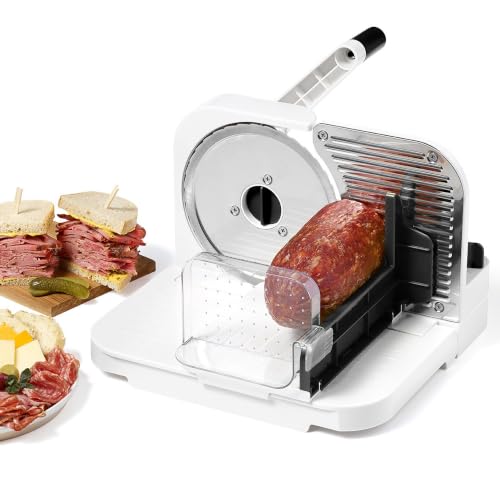
- Slices meat, cheese, and bread
- Adjusts from deli-thin to 1 inch
- Foldable, dishwasher-safe design with safety features
Best For: Compact everyday slicing across common deli foods
Best for Fresh Meat Prep
17-Blade Manual Fresh Meat Slicer

- Slices 18 pieces in one pass
- Includes 2 mm and 4 mm blade sets
- Designed for fresh, boneless meat
Best For: Home cooks preparing fresh meat for hot pot or barbecue
Best Electric Alternative
Nutrichef 200W Meat and Deli Slicer

- 200W automatic slicing power
- Adjusts from 0 to 15 mm
- Removable blade and food carriage
Best For: Home users wanting powered, adjustable slicing
Best for Frozen Cuts
Adjustable Manual Frozen Meat Slicer

- Cuts from 0.5 to 25 mm thick
- Built for properly frozen meat
- Includes two blades and useful accessories
Best For: Home cooks preparing frozen beef, lamb, bacon, or cheese
Compact Frozen Prep Pick
Adjustable Stainless Steel Slicer

- 0.3–8mm adjustable thickness
- Four suction cups and meat press cover
- Foldable, detachable stainless steel body
Best For: Home cooks slicing fully frozen meat for hot pot and BBQ
Versatile Frozen-Slice Pick

- For frozen or semi-frozen meat
- Includes an extra replacement blade
- Safety pusher and anti-slip base
Best For: Home users wanting adjustable cuts and blade backup
Wide-Range Thickness Pick
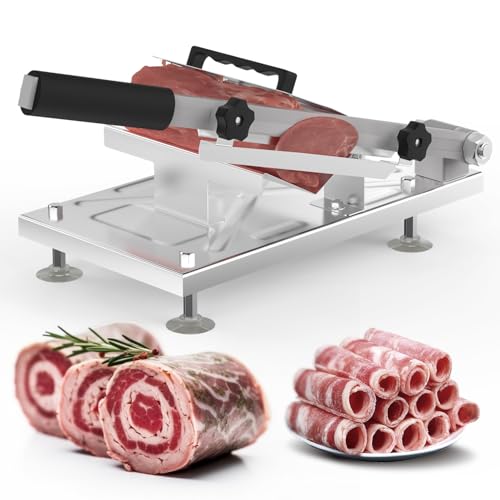
- 0.2–20mm adjustable thickness
- Thickened 1.5mm stainless steel board
- Spare blade and useful prep accessories included
Best For: Home cooks needing thin or thick frozen-meat slices
Best Frozen-Meat Value – Befen Adjustable Frozen Meat Slicer
For shoppers comparing manual meat slicers, the Befen is designed specifically for properly frozen beef, lamb, chicken, ham, and fish. Its stainless-steel construction and broad thickness range make it a flexible option for hot pot, stir-fry, sandwiches, pizza toppings, and jerky preparation.
Best For: Home cooks who regularly slice frozen meat into thin, adjustable portions.
Pros:
- Adjustable slice thickness from 0.2 to 20 mm.
- Includes two blades, a meat holder, meat bags, suction cups, and an Allen wrench.
- Uses a 1.5 mm stainless-steel board designed to withstand pressure.
- Can help reduce the cost of buying pre-sliced meat.
Cons:
- Requires meat to be properly frozen for clean cuts.
- Hand-wash care is recommended.
- Manual slicing requires more effort than an electric slicer.
This is a practical choice when thin frozen-meat slices are the priority. Follow the included instructions and freeze ingredients correctly before use.
Best Fresh-Meat Batch Slicer – SupMaKin 17-Blade Fresh Meat Slicer
Among manual meat slicers, the SupMaKin stands out for cutting fresh meat into multiple portions in one stroke. Its 17-blade design produces 18 slices, while interchangeable blade sets support either 2 mm or 4 mm cuts.
Best For: Home cooks preparing fresh pork, beef, chicken breast, or salmon for hot pot, jerky, sushi, or strips.
Pros:
- Seventeen blades can create 18 slices in one stroke.
- Offers 2 mm and 4 mm thickness options.
- SteadyGrip suction cup helps secure the slicer to a smooth countertop.
- Includes a cleaning brush and has a compact, wall-mountable design.
Cons:
- Not suitable for frozen or deli meat.
- Hand-wash care is specified.
- Provides fewer thickness choices than continuously adjustable slicers.
Choose this model for speed and repeatable thin cuts from fresh ingredients. It is less versatile if you need to process frozen meat or vary thickness beyond 2 and 4 mm.
Best Heavy-Duty Cutting Range – CGOLDENWALL Manual Bone and Meat Slicer
For buyers seeking manual meat slicers with broader cutting capability, the CGOLDENWALL is built for meat, vegetables, frozen food, and some smaller-boned ingredients. Its two screw sizes allow thickness settings from 0 to 8 mm or 0 to 57 mm.
Best For: Users who want one manual cutter for thin slices, thicker cuts, vegetables, and selected poultry or small-rib preparations.
Pros:
- Forged and polished 4Cr13 steel blades are designed for powerful cutting.
- Two screw sizes provide wide thickness adjustment ranges.
- Support feet and a table-gripping design help improve stability.
- Includes a food storage shovel to catch cut ingredients.
Cons:
- Cannot cut beef ribs, trotters, large ribs, or cow bones.
- Hard ingredients may require sharpening and firm, quick pressure.
- Hand-wash care is recommended.
This model offers the widest stated cutting range in the group, but its bone-cutting limits matter. Treat it as a versatile manual food cutter rather than a tool for large or very hard bones.
Best All-Around Deli Slicer – Starfrit Adjustable Deli Slicer
The Starfrit is one of the more versatile manual meat slicers for everyday kitchen use because it handles meat, cheese, and bread. Its 6.5-inch serrated rotary blade adjusts from deli-thin slices to 1 inch, while the carriage and safety accessories support controlled operation.
Best For: Kitchens that need a compact slicer for deli foods, cheese, bread, and adjustable meat portions.
Pros:
- Adjusts from very thin slices up to 1 inch thick.
- 6.5-inch stainless-steel serrated blade handles meat, cheese, and bread.
- Large non-slip suction base, food pusher, carriage, and thumb guard add stability and control.
- Detachable components are dishwasher safe, and the design folds for storage.
Cons:
- Its 6.5-inch blade may be less suitable for very large cuts.
- Plastic and stainless-steel construction may not suit shoppers seeking an all-metal slicer.
- Manual operation requires pushing the carriage by hand.
This is a strong everyday option when versatility, safety features, and easy cleanup matter. Its foldable design is particularly useful for kitchens with limited storage space.
Best for Fresh Meat Prep – 17-Blade Manual Fresh Meat Slicer
Among manual meat slicers, this model is designed specifically for fresh, boneless cuts rather than frozen or cooked meat. Its 17-blade setup produces 18 slices at once, while interchangeable blade sets provide 2 mm or 4 mm thickness options for hot pot, barbecue, and home meal prep.
Best For: Home cooks slicing fresh, boneless chicken, pork, beef, lamb, or salmon.
Pros:
- Creates 18 slices in one pass with 17 blades.
- Offers 2 mm and 4 mm thickness options.
- Detachable parts simplify cleaning and storage.
- A large suction cup helps stabilize the slicer on smooth surfaces.
Cons:
- Not suitable for frozen, cooked, or bone-in meat.
- The very sharp blade assembly requires careful handling and brush cleaning.
- The base is not recommended for dishwasher use.
This is a focused choice for fresh-meat preparation when speed and consistent thin slices matter. Its narrow thickness range and manual operation make it less versatile than an adjustable frozen-meat slicer, but the high-volume blade design can be useful for hot pot and barbecue prep.
Best Electric Alternative – Nutrichef 200W Meat and Deli Slicer
If you are comparing manual meat slicers but want powered operation, the Nutrichef provides an automatic countertop alternative. Its 200W motor, removable 7.5-inch stainless steel blade, and dial-adjustable 0–15 mm cutting range support slicing meat, deli foods, and bread.
Best For: Home users who prefer powered slicing with adjustable thickness and a compact countertop design.
Pros:
- 200W motor supports automatic slicing.
- Dial adjusts thickness from 0 to 15 mm.
- Removable blade and food carriage help with cleaning.
- Safety guard, food pusher, and safety lock add control during use.
Cons:
- It is automatic rather than a manual slicer.
- Care instructions specify hand washing only.
- Its 7.5-inch blade may be limiting for especially large cuts.
This model makes sense when reduced hand effort is more important than choosing a strictly manual design. The broad thickness range and removable components add flexibility, while the 13.9-by-9.9-by-10.9-inch footprint remains manageable for home storage.
Best for Frozen Cuts – Adjustable Manual Frozen Meat Slicer
This heavy-duty option stands out among manual meat slicers for frozen-meat preparation. Its reinforced stainless steel frame, 420-grade blade, and adjustment knob cover thicknesses from 0.5 to 25 mm, making it suitable for thin sandwich cuts as well as thicker slices for stir-fries and jerky.
Best For: Home cooks slicing properly frozen beef, lamb, bacon, cheese, and vegetables.
Pros:
- Adjusts from 0.5 to 25 mm for broad slicing control.
- Reinforced stainless steel construction is designed for frozen meats.
- Detachable blade supports cleanup and replacement.
- Includes two blades, a meat holder, bags, sharpening stone, and Allen wrench.
Cons:
- Requires meat to be frozen at -10°C or below for at least 24 hours for best results.
- Not intended for bones or other hard objects.
- Hand wash only.
Choose this slicer when adjustable thickness and frozen-food capability are priorities. The manual frame and included accessories add practical value, while the larger 16.1-inch length and 5.7-pound weight suggest a sturdier setup than compact fresh-meat slicers.
Compact Frozen Prep Pick – Adjustable Stainless Steel Slicer
This compact option is one of the more straightforward manual meat slicers for home cooks who regularly prepare fully frozen beef, mutton, ham, or similar foods. Its 0.3–8mm adjustment range, suction cups, and detachable stainless steel construction support controlled slicing for hot pot, BBQ, and sukiyaki.
Best For: Home cooks slicing fully frozen meat for hot pot, BBQ, and sukiyaki.
Pros:
- Adjustable slicing thickness from 0.3 to 8mm.
- Four non-slip suction cups and a meat press cover help stabilize ingredients.
- Detachable stainless steel design is intended for thorough hand cleaning.
- Foldable construction supports compact storage.
Cons:
- Designed for fully frozen food blocks only; it is not intended for fresh meat, bones, soft cheese, or hard-shell foods.
- Hand wash only.
- Thickness adjustment requires synchronous turning and tightening of the knobs and inner nuts.
Choose this model if countertop space and storage are priorities and your slicing needs center on properly frozen ingredients. The compact format is practical, but the frozen-food-only limitation should guide your expectations.
Versatile Frozen-Slice Pick – ZOMAT Adjustable Meat Slicer
The ZOMAT is a practical choice among manual meat slicers for home kitchens that need adjustable cuts from frozen or semi-frozen meat. Its stainless steel body, safety pusher, anti-slip base, and included replacement blade are useful features for repeated hot pot, sandwich, BBQ, or meal-prep use.
Best For: Home users who want adjustable slices and a spare blade for frozen or semi-frozen meat.
Pros:
- Works with frozen or semi-frozen beef, lamb, pork, and chicken.
- Includes an extra replacement blade.
- Adjustable thickness accommodates thin or thicker cuts.
- Non-slip base, ergonomic handle, and safety pusher support steadier operation.
Cons:
- Not designed for fresh or raw meat.
- Hand wash only and should be dried thoroughly after cleaning.
- Adjustable thickness measurements are not specified in the supplied details.
This model stands out when a replacement blade and a little more flexibility around meat temperature matter. It remains a manual, hand-wash appliance, so it is best suited to buyers comfortable with basic preparation and cleanup.
Wide-Range Thickness Pick – Upgraded Frozen Meat Cutter
This upgraded manual meat slicer is aimed at home cooks who want a broad thickness range and a substantial accessory package. It handles properly frozen beef, mutton, pork, ham, and fish, with settings from 0.2 to 20mm for hot pot, BBQ, sandwiches, jerky, and other home-cooking tasks.
Best For: Home cooks who want very thin hot-pot slices as well as thicker cuts from frozen ingredients.
Pros:
- Offers a wide 0.2–20mm adjustable thickness range.
- Uses a 7.9-inch blade and a thickened 1.5mm stainless steel board.
- Includes a spare blade, 10 food bags, meat holder, Allen wrench, and manual.
- Suitable for frozen meat and fish across hot pot, BBQ, sandwiches, and jerky preparation.
Cons:
- Requires meat to be properly frozen for best results.
- Hand wash only.
- At about 17.7 inches long and 3 pounds, it may need more storage space than compact models.
The standout feature here is flexibility: the unusually broad adjustment range lets one slicer cover both ultra-thin and thicker preparations. Consider it if the accessory bundle and reinforced board appeal more than having the smallest possible countertop footprint.
How We Picked the Best Manual Meat Slicers
We focused on the features that matter most during real home use: the types of meat each slicer is designed to handle, blade or cutter construction, available thickness settings, countertop stability, and how easily the food-contact parts can be cleaned. We also considered whether a model is better suited to frozen meat, semi-frozen portions, fresh meat, vegetables, hot pot preparation, or deli-style slicing.
Because manual designs vary widely, we did not treat every option as interchangeable. Some prioritize compact storage and occasional use, while others offer heavier construction or specialized cutting capacity. The goal is to match each design with the job it performs best.
Quick Comparison
| Best For | Look For | Trade-Off |
|---|---|---|
| Frozen meat and hot pot | Stainless steel construction and adjustable thin cuts | Requires more physical effort |
| Fresh meat | Steady grip, guided cutting, and 2–4 mm settings | May have a narrower use range |
| Deli meat and bread | Adjustable thickness dial and guarded blade | Often less specialized for hard-frozen meat |
| Bone or rib cutting | Heavy-duty cutter and rigid frame | Bulkier and harder to clean |
| Occasional kitchen use | Compact footprint and simple manual operation | Lower throughput than electric models |
Key Buying Factors for Manual Meat Slicers
Meat Compatibility
Check whether the slicer is intended for fully frozen, semi-frozen, or fresh meat. Frozen-meat models are useful for hot pot and shaved beef, but they may not deliver the cleanest results on soft fresh cuts. For deli meat, bread, or vegetables, a more conventional slicer may be the better choice.
Thickness Control
Fixed 2 mm or 4 mm settings can be convenient when you regularly prepare one style of cut. Adjustable models provide greater flexibility, but confirm that the adjustment mechanism holds its setting securely and produces consistent slices.
Stability and Handling
A stable base, clamps, feet, or a secure grip can make a bigger difference than an extra blade feature. Manual cutting requires controlled pressure, so avoid designs that slide, flex, or leave your hands close to an exposed cutting edge.
Materials and Cleanup
Stainless steel is a practical choice for durability and food-contact surfaces, but construction alone does not guarantee easy maintenance. Look for removable parts, accessible crevices, and components that can be thoroughly dried after washing. Always follow the manufacturer’s cleaning instructions.
Safety
Use a pusher, holder, or protective glove when provided, and keep fingers away from the blade or cutting slot. Secure the slicer before each cut, work slowly, and never force meat through a mechanism that is binding.
Who Should Buy Which Manual Meat Slicers?
Choose a Frozen-Meat Slicer If:
You prepare shabu-shabu, hot pot, cheesesteaks, shaved beef, or thin pork and lamb portions. These Manual Meat Slicers are most useful when the meat is firm enough to guide cleanly through the cutter.
Choose a Fresh-Meat Model If:
You mainly portion fresh boneless cuts and want straightforward 2 mm or 4 mm slicing. Prioritize a steady grip and simple adjustment over specialized frozen-meat capacity.
Choose a Heavy-Duty Cutter If:
You need to process tougher ingredients, ribs, or harder portions and have sufficient counter space. Confirm the model’s intended food types and handling requirements before buying.
Consider an Electric Slicer Instead If:
You slice large quantities frequently or need broad thickness control with less manual effort. Electric models can improve throughput, though they usually require more storage, cleaning, and setup. For occasional small batches, a compact manual model is often the simpler choice.