Making pasta for a crowd demands more than a basic countertop roller. The best pasta machines for large batches combine useful capacity, consistent dough handling, durable construction, and cutters that match the shapes you serve most often.
This roundup compares commercial electric machines, automatic extruders, and proven manual rollers to help you choose a model that fits your kitchen, workflow, and production volume.
Best 10 Pasta Machines for Large Batches Picks for 2026
Heavy-Duty Pick
YIMOHOME Commercial Electric Pasta Maker

- 750W motor for demanding workloads
- Presses, cuts, and kneads dough
- Multiple cutters and adjustable thickness
Best For: Restaurants and high-volume home kitchens
Family-Size Choice
Philips 7000 Series Pasta Maker

- Produces up to eight portions
- Automatic mixing and extrusion
- Eight discs plus dishwasher-safe parts
Best For: Families and convenient home pasta making
Commercial Value Pick
Newhai 750W Electric Pasta Maker

- 750W motor with steel gears
- Presses and cuts in one workflow
- 0.12–18mm thickness adjustment
Best For: Small businesses and robust home kitchens
Manual Alternative

- Compact 2.6kg manual design
- Ten thickness settings
- Makes lasagna, fettuccine, and tagliolini
Best For: Hands-on home pasta making
Commercial Electric Pick

- 550W motor for repeated rolling and cutting
- 2mm and 6mm noodle cutters
- 0.1–5mm adjustable dough sheets
Best For: Restaurants and serious home kitchens making frequent large batches
Manual Family-Batch Pick
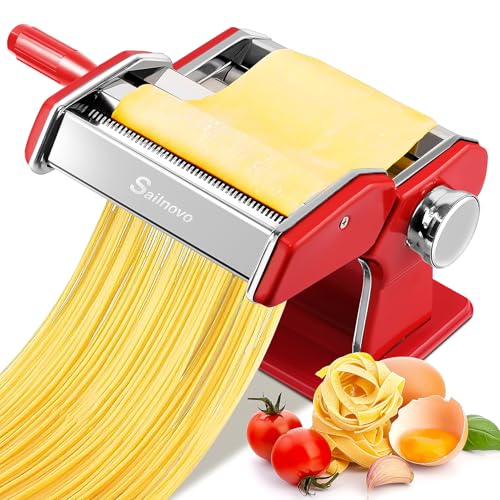
- Nine thickness settings from 0.3–3mm
- 2mm and 6.25mm noodle cutters
- Detachable, rust-resistant design
Best For: Families and home cooks who enjoy hands-on pasta making
High-Output Electric Pick
LeoneBeBe Commercial Noodle Maker

- 550W automatic operation
- Stated output of 45–55 pounds per hour
- 3mm and 9mm dual noodle cutters
Best For: Commercial kitchens and households needing rapid, repeated noodle production
Manual Flexibility

- Nine thickness settings from 0.5–3 mm
- Two cutter widths for several pasta styles
- Rust-resistant manual construction
Best For: Hands-on home cooks making varied pasta
Easy Batch Automation
VEVOR 150W Electric Pasta Maker

- 500 g flour capacity for about four people
- Four automatic modes reduce hands-on work
- Eight molds and dishwasher-safe parts
Best For: Families making convenient home noodle batches
Commercial Output
Koalalko Full-Automatic Pasta Machine

- 10–25 kg per hour production capacity
- 2.2 kW automatic extrusion system
- Includes three molds with more available
Best For: Restaurants, bakeries, and food-processing operations
Heavy-Duty Pick – YIMOHOME Commercial Electric Pasta Maker
For shoppers comparing pasta machines for large batches, this YIMOHOME model is built around high output and commercial-style construction. Its 750W motor, stainless-steel roller and cutter, and claimed capacity of 45–66 pounds of fresh noodles per hour make it suited to demanding kitchen workloads.
Best For: Restaurants, serious home cooks, and anyone needing high-volume pasta, dough sheets, or dumpling wrappers.
Pros:
- 750W all-copper motor with cast-iron gears.
- Combines kneading, pressing, and cutting in one machine.
- Adjustable dough thickness and multiple cutter options.
- Fully stainless-steel roller and cutter components.
Cons:
- At about 46 pounds, it requires substantial counter or storage space.
- The commercial build may be more machine than occasional users need.
Choose this model when throughput and durability matter more than compactness. Its broad adjustment range and cutter selection also make it useful beyond standard pasta, including dumpling skins and other rolled doughs.
Family-Size Choice – Philips 7000 Series Pasta Maker
The Philips 7000 Series is a more approachable option among pasta machines for large batches, producing up to eight portions automatically. It mixes and extrudes pasta in under 10 minutes, while dishwasher-safe parts and app guidance simplify regular family use.
Best For: Families and home cooks who want automated, portion-sized pasta making with minimal hands-on work.
Pros:
- Makes up to eight portions in one go.
- Automatic operation with eight shaping discs.
- Mixing function can also help with cookies, pizza, and bread preparation.
- Non-stick, dishwasher-safe parts support easier cleanup.
Cons:
- Its stated capacity is intended for household portions rather than restaurant-scale production.
- It offers less dough-thickness range than the commercial machines in this roundup.
This is a strong fit when “large batch” means feeding family and friends rather than running continuous commercial production. The automatic process, recipe support, and cleanup-friendly design make it particularly convenient for frequent home use.
Commercial Value Pick – Newhai 750W Electric Pasta Maker
For buyers seeking pasta machines for large batches without giving up thickness control, the Newhai combines a 750W motor with pressing and cutting functions. Its 0.12–18mm adjustment range supports pasta sheets, dumpling wrappers, and other dough preparations in home or restaurant settings.
Best For: Small food businesses and home users who need a sturdy electric press-and-cut machine.
Pros:
- 750W motor and heavy-duty steel gears.
- Presses dough and cuts noodles without blade removal.
- Adjustable thickness from 0.12 to 18mm.
- Non-slip pads and double-belt transmission support stable operation.
Cons:
- Automatic safety shutdown occurs after 1–2 hours of continuous operation.
- Users must allow 10–20 minutes for cooling before restarting.
- At 22kg, it is not especially portable.
The Newhai makes sense for batch-oriented users who value strong construction and versatile sheet thickness. Its cooling cycle is an important consideration for uninterrupted commercial workflows, but it should be manageable for scheduled production periods.
Manual Alternative – Marcato Atlas150 Pasta Maker
MARCATO Atlas150 Manual Pasta Maker Machine-LASAGNA, FETTUCCINE & TAGLIOLINI. Made in Italy
Check Price On AmazonThe Marcato Atlas150 is a manual alternative to electric pasta machines for large batches. It does not match powered models for speed or volume, but its compact 2.6kg design and 10 settings offer hands-on control for lasagna, fettuccine, and tagliolini.
Best For: Home cooks who prefer manual control and make moderate batches of classic pasta shapes.
Pros:
- Compact and relatively lightweight at 2.6kg.
- Ten settings provide control over sheet thickness.
- Designed for lasagna, fettuccine, and tagliolini.
- Made with chrome-plated or nickel-plated steel components.
Cons:
- Manual operation requires more time and physical effort.
- It is less suitable for high-volume production than the electric models.
- The supplied configuration lists three discs rather than a broad commercial cutter set.
Select the Atlas150 if compact storage and traditional hands-on preparation matter more than maximum throughput. For truly large batches, an electric machine will be more efficient, but this model remains a practical choice for controlled household production.
Commercial Electric Pick – XINGYUEXUAN 550W Pasta Maker
For pasta machines for large batches, the XINGYUEXUAN stands out with a 550W motor, electric operation, and a stainless steel commercial-style body. Its adjustable roller gap supports everything from thin pasta sheets to thicker dough for dumplings, wontons, ravioli, and lasagna.
Best For: Restaurants, food-prep businesses, and serious home cooks making repeated batches of pasta or dough sheets.
Pros:
- 550W motor is designed for repeated rolling and cutting.
- Dual 2mm and 6mm cutters handle two noodle widths without changing the cutter assembly.
- Adjustable 0.1–5mm roller gap supports pasta, wrappers, and other dough recipes.
- Stainless steel construction suits daily kitchen preparation.
Cons:
- At 42.3 pounds, it is substantially heavier than a manual countertop pasta maker.
- Semi-automatic operation still requires feeding and managing the dough.
- The commercial footprint may be more machine than occasional home users need.
This is a strong choice when throughput and versatility matter more than portability. The electric roller and practical cutter sizes make it particularly suitable for kitchens that prepare fresh noodles or wrappers regularly.
Manual Family-Batch Pick – Sailnovo 3-in-1 Pasta Maker
The Sailnovo is a practical entry point for pasta machines for large batches when you prefer hands-on preparation. Its hand crank, nine thickness settings, and two cutter widths provide flexibility for spaghetti, fettuccine, lasagna, dumplings, and other dough-based dishes.
Best For: Families and home cooks who want adjustable pasta thickness, simple manual control, and an approachable machine for group cooking.
Pros:
- Nine thickness settings range from 0.3–3mm for varied recipes.
- Two cutter widths produce 2mm or 6.25mm noodles.
- Food-grade materials and a detachable structure support regular use and cleanup.
- Lightweight, rust-resistant aluminum-alloy rollers are easy to handle.
Cons:
- Manual operation requires more effort for especially large or repeated batches.
- It does not provide the motorized throughput of the commercial electric models.
- The supplied notes recommend dry cleaning rather than washing the machine with water.
The Sailnovo offers the most accessible format in this group. Its range of settings is useful for varied menus, but buyers prioritizing speed and high-volume production may prefer an electric model.
High-Output Electric Pick – LeoneBeBe Commercial Noodle Maker
Among pasta machines for large batches, this LeoneBeBe model is built for higher-volume work, with a 550W motor and a stated production capacity of 45–55 pounds of noodles per hour. Its automatic design combines pressing and cutting for pasta, dumpling wrappers, wonton skins, and other dough products.
Best For: Noodle shops, breakfast businesses, snack bars, and households that need fast, repeated dough processing.
Pros:
- Automatic 550W operation is designed for commercial and household use.
- Stated workload reaches 45–55 pounds of fresh noodles per hour.
- Dual 3mm and 9mm cutters produce two noodle widths.
- Adjustable 0.1–5mm dough thickness supports noodles and wrappers.
Cons:
- At about 44–46 pounds, it is heavy to move frequently.
- The 3mm and 9mm cutter sizes offer less width variety than some alternatives.
- Its commercial-oriented design may be excessive for occasional pasta making.
This model is the clearest fit for buyers who put batch capacity first. The automatic operation and stated hourly output make it better suited to demanding prep schedules than a manual machine.
Manual Flexibility – Sailnovo 3-in-1 Pasta Maker
For cooks comparing pasta machines for large batches, the Sailnovo is a manual option with a stainless steel body, a clamp, and nine thickness settings. It is better suited to hands-on batch preparation than high-volume production, but its adjustable roller and two cutter widths cover common pasta styles.
Best For: Home cooks who want adjustable sheets for spaghetti, fettuccine, lasagna, or dumpling skins and prefer manual control.
Pros:
- Nine thickness settings range from 0.5 to 3 millimeters.
- Includes cutters for 2.0 mm and 4.5 mm pasta widths.
- Stainless steel and aluminum construction is designed to resist rust.
- Lightweight design and included clamp make it practical for home kitchens.
Cons:
- Manual operation requires more effort for repeated large batches.
- The blade attachment should not be washed with water or placed in a dishwasher.
- It offers fewer pasta shapes than an extruding machine.
The Sailnovo makes sense when versatility and control matter more than automation. For genuinely high-volume production, a motorized or commercial machine will be more efficient.
Easy Batch Automation – VEVOR 150W Electric Pasta Maker
Among pasta machines for large batches, the VEVOR stands out for automated mixing and extrusion. Its 500-gram flour capacity can produce enough noodles for about four people in roughly 14 minutes, while four automatic modes and eight included molds reduce hands-on work.
Best For: Home kitchens that want convenient, repeatable noodle batches with multiple shapes and less manual kneading.
Pros:
- 500 g flour capacity is sized for a family batch.
- Four automatic modes simplify mixing and noodle making.
- Eight pasta discs provide a range of shapes.
- Parts are dishwasher-safe, and a brush and spatula are included.
Cons:
- Water ratios need to be followed carefully to prevent sticking or failed extrusion.
- The stated capacity is suitable for home batches, not continuous commercial production.
- At 11 pounds, it is less lightweight than a simple manual roller.
The VEVOR is a practical middle ground for frequent home batch making: more convenient than a hand-cranked roller, though not designed for the output of commercial equipment.
Commercial Output – Koalalko Full-Automatic Pasta Machine
For buyers specifically seeking pasta machines for large batches, the Koalalko is the clear production-focused choice. This full-automatic stainless steel extruder is rated for 10–25 kg per hour and operates at 2.2 kW, making it intended for bakeries, restaurants, snack businesses, and food-processing settings.
Best For: Commercial kitchens and food businesses needing high-volume extruded spaghetti, penne, fusilli, or similar pasta.
Pros:
- Production capacity is listed at 10–25 kg per hour.
- Automatic extrusion supports commercial-scale workflow.
- Includes Fusilli, spaghetti, and penne molds.
- Additional dies can expand the available pasta shapes.
Cons:
- Its 176-pound weight and 19.7-by-18.5-by-30.7-inch footprint require dedicated space.
- It uses 2.2 kW at 110 V, so the installation should accommodate its power needs.
- Only three molds are included; other dies cost extra.
The Koalalko is the strongest match for true large-batch production, but its commercial size, power requirements, and additional-die costs make it excessive for ordinary home use.
How We Picked the Best Pasta Machines for Large Batches
We focused on the features that matter when producing repeated batches: motor power, flour or dough capacity, roller and cutter options, construction, operating speed, cleanup, and ease of use. We also considered whether each machine is better suited to a home kitchen, catering operation, restaurant, or higher-volume production setting.
Electric machines generally reduce rolling and cutting time, while manual models can offer excellent control with fewer mechanical parts. Capacity claims should be treated as practical guidelines rather than guarantees, since dough hydration, flour type, and rest time affect performance.
Quick Comparison
| Best For | Look For | Most Suitable Type |
|---|---|---|
| Frequent restaurant production | High-wattage motor, stainless-steel body, continuous workflow | Commercial electric machine |
| Several pasta shapes at home | Multiple discs, preset programs, simple cleanup | Automatic extruder |
| Lasagna and ribbon pasta | Adjustable thickness and interchangeable cutters | Manual roller |
| Small catering or family batches | Balanced capacity, compact footprint, reliable cutters | Midrange electric roller |
Key Buying Factors for Pasta Machines for Large Batches
Capacity and Batch Workflow
Check the stated flour or dough capacity, then leave room for mixing and shaping. A machine that handles one large batch may still require pauses for feeding, cutting, or cooling. For service kitchens, continuous operation and easy access to the feed area can matter more than the headline capacity.
Motor Power and Construction
Higher wattage can help with dense dough and repeated use, but power alone does not determine durability. Stainless-steel housings, sturdy rollers, stable feet, and protected drive components are useful indicators for demanding work. Confirm whether the machine is intended for commercial duty before using it continuously.
Shapes, Thickness, and Adjustability
Choose cutters based on the pasta you actually prepare. Roller machines are strong choices for lasagna, fettuccine, and tagliolini, while extruders provide more shape variety. Multiple settings are valuable only when they remain easy to adjust and clean.
Cleaning and Counter Space
Look for removable accessories, accessible dough paths, and clear cleaning instructions. Measure your available counter and storage space, especially for commercial machines with wide bodies or tall feed hoppers. Never assume a component is dishwasher-safe unless the manufacturer confirms it.
Who Should Buy Which Pasta Machines for Large Batches?
Choose a commercial electric model if you run a restaurant, catering service, or busy household that needs repeated batches with less manual effort.
Choose an automatic home extruder if convenience and shape variety matter most, and your typical batches are moderate rather than continuous.
Choose a manual Marcato-style roller if you prioritize hands-on control, traditional rolling, and dependable sheets or ribbon pasta over maximum automation.
Choose a compact 3-in-1 electric roller for occasional large family meals or small catering jobs where versatility, storage, and price need to stay balanced.